

B2B marketing teams need to reach the right decision-makers, understand buyer intent, create relevant content, and generate qualified leads while managing limited resources. Traditional marketing methods remain valuable, but manual research, repetitive tasks, and disconnected data can slow down results. This is where AI marketing tools can help teams improve efficiency and make better-informed decisions.
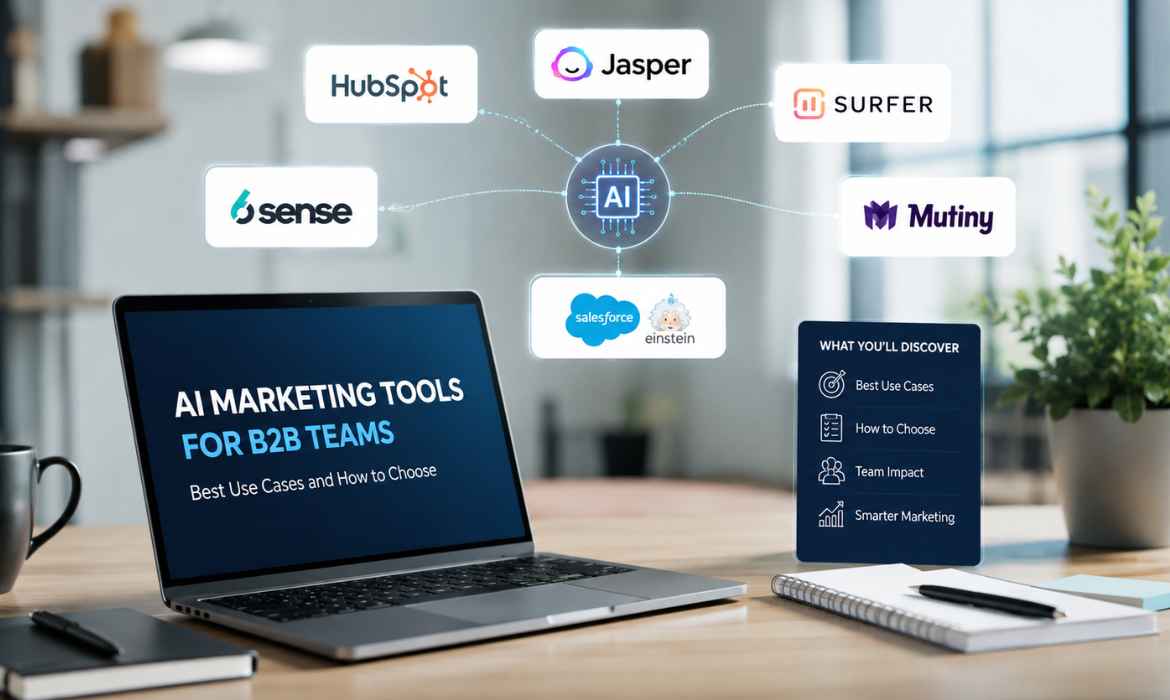
Today, platforms such as HubSpot, Jasper, Surfer SEO, 6sense, Mutiny, and Salesforce Einstein offer different capabilities for content creation, marketing automation, search optimization, account intelligence, and personalization. Understanding what each platform does can help B2B marketers identify solutions that match their business needs.
However, choosing the right software requires more than comparing features. Teams must consider their marketing objectives, existing technology, data quality, and performance goals. The right approach connects AI capabilities with practical business outcomes, including qualified leads, stronger account engagement, and pipeline growth.
What Are AI Marketing Tools?
AI marketing tools are software applications that use artificial intelligence to support activities such as content development, customer segmentation, campaign automation, predictive analytics, and performance measurement. Depending on the platform, these capabilities may include generative AI, machine learning, and natural language processing.
For example, a content team can use AI to develop article outlines, while a demand generation team can analyze account information to prioritize potential buyers. Marketing automation platforms can also help teams manage follow-ups and deliver more relevant communication.
In B2B marketing, these capabilities are especially useful because purchasing decisions often involve multiple stakeholders and extended evaluation periods. AI marketing tools can help teams analyze available information, identify patterns, and coordinate activities throughout the buying journey.
Best AI Marketing Tools for B2B Teams
Different AI marketing tools solve different problems. Some focus on content production, while others support lead management, account prioritization, or personalized marketing experiences. The following platforms are worth evaluating based on your team’s requirements.
1. HubSpot for Marketing Automation and Lead Management
HubSpot combines customer relationship management (CRM) with marketing, sales, and customer engagement capabilities. Its AI features can support content creation, workflow automation, customer data management, and campaign activities, depending on the products and subscription selected.
B2B teams can use HubSpot to organize contact information, manage leads, automate follow-ups, and monitor prospect engagement. These capabilities help marketers connect campaign activities with the wider sales process.
For example, a demand generation team could create a workflow for prospects who download a whitepaper. The team can organize contacts, deliver relevant follow-up content, and track subsequent interactions within its marketing and CRM processes.
HubSpot is worth considering when a business wants to connect lead management, marketing automation, and customer data within one platform.
2. Jasper for B2B Content Creation
Jasper is an AI-powered marketing content platform that helps teams develop and adapt written content for different channels. Depending on the workflow, marketers can use it to prepare initial drafts, campaign messaging, landing page copy, and other marketing assets.
For B2B teams, Jasper can support content production across blogs, email campaigns, social media, and landing pages. It can also help marketers adapt existing material for different audiences while maintaining a consistent brand voice.
For example, a company publishing an article about account-based marketing could use Jasper to prepare an initial LinkedIn post and email draft. A human editor would then refine the messaging, verify the facts, and ensure that the content reflects the company’s expertise.
Jasper is particularly relevant for teams that produce marketing content regularly and want to streamline their workflows without removing editorial oversight.
3. Surfer SEO for Search Optimization
Surfer SEO supports content optimization by helping marketers evaluate relevant topics, terms, and content structure. Its capabilities can assist SEO teams as they plan and refine articles for organic search.
B2B organizations rely on search visibility to attract buyers researching industry challenges, evaluating solutions, or comparing approaches. Surfer SEO can help content teams assess whether their articles cover relevant subtopics and align with the intended search query.
For instance, a team creating an article about B2B lead qualification could use Surfer SEO to identify relevant content topics and improve its on-page structure. Editors should still ensure that the article provides useful information rather than adding keywords simply to increase their frequency.
Surfer SEO is worth evaluating when organic visibility and content optimization are important priorities. It works best alongside keyword research, original insights, and a clear understanding of search intent.
4. 6sense for Buyer Intent and Account Prioritization
6sense is a B2B revenue intelligence and account-based marketing platform that helps organizations identify and prioritize potential buying accounts. Its capabilities can support account selection, intent analysis, and coordination between marketing and sales.
B2B teams often need to determine which organizations fit their ideal customer profile and which accounts may be showing meaningful buying signals. Account intelligence can help marketers prioritize their efforts using available company information and intent-related insights.
For example, a company selling enterprise technology solutions could use account intelligence to identify organizations that match its target market. Marketing could then develop relevant campaigns while sales investigates whether those accounts have suitable business needs.
6sense is worth considering for organizations with established account-based marketing programs and a need to coordinate marketing and sales around target accounts. Its insights should be evaluated alongside account fit and other available evidence.
5. Mutiny for B2B Personalization
Mutiny focuses on B2B go-to-market workflows and personalized marketing experiences. Its capabilities can help teams create more relevant assets and support marketing activities for selected audiences.
Website personalization can be useful when different industries or account segments have different priorities. For example, a manufacturing company may care about operational efficiency, while a financial services company may focus on security and compliance.
B2B marketers can use personalization capabilities to adapt website messaging and marketing experiences to the needs of selected audiences. This helps potential buyers find information that better reflects their business context.
Mutiny is worth evaluating when a team wants to strengthen account-focused marketing experiences. Before choosing it, businesses should review its current capabilities, integrations, and pricing against their specific requirements.
6. Salesforce Einstein for CRM Intelligence
Salesforce Einstein provides AI capabilities across Salesforce products, including sales and marketing workflows. Depending on the product configuration, these capabilities can support predictive insights, content assistance, personalization, and workflow automation.
B2B teams can use AI-supported CRM workflows to organize customer information, assist with communication, and inform decisions using available business data.
For example, a marketing team using Salesforce could explore AI-assisted campaign creation and personalized customer journeys. Sales representatives may also benefit from AI-generated summaries and assistance within their existing workflows.
Salesforce Einstein is relevant for organizations already using Salesforce that want to extend their CRM processes with AI. Teams should evaluate the capabilities available in their specific products and subscriptions before making a decision.
Best Use Cases for AI Marketing Tools in B2B
Understanding individual platforms is only the first step. Teams also need to connect each tool with a clear marketing objective.
Lead Generation and Qualification
AI marketing tools can help marketers organize prospect information, analyze account characteristics, and prioritize potential leads. Predictive lead scoring can identify patterns associated with previous conversions and help teams focus on promising prospects.
However, engagement alone does not establish lead quality. Marketers should consider company fit, business needs, available intent signals, and sales feedback when determining whether a lead is ready for further engagement.
Content Creation and SEO
Generative AI can assist with research, outlines, initial drafts, and content repurposing. SEO platforms can help marketers identify relevant topics and improve on-page content structure.
Human expertise remains essential for factual accuracy, originality, and search intent alignment. B2B teams should use AI to support content development rather than rely on it to produce large volumes of generic articles.
Account-Based Marketing and Personalization
AI can support account prioritization and help marketers adapt messaging for different audiences. Account intelligence platforms and personalization tools are especially relevant when marketing and sales teams coordinate their activities around selected companies.
For example, marketers can develop different content experiences for technical decision-makers and financial stakeholders. The objective is to provide useful information that reflects each audience’s priorities.
Campaign Automation and Performance Analysis
Marketing automation platforms can support follow-ups, audience segmentation, and campaign workflows. AI-assisted analytics may help teams identify engagement patterns and understand where campaigns need improvement.
Performance should be evaluated using qualified leads, conversion rates, sales acceptance, and pipeline contribution. These metrics provide more business context than email opens or the volume of content produced.
How to Choose the Right AI Marketing Tools
The best AI marketing tools are not necessarily the platforms with the largest number of features. The right choice depends on your team’s objectives, existing systems, and ability to measure results.
Start With a Clear Marketing Objective
Identify the problem you want to solve before comparing vendors. Your priority might be reducing content production time, improving lead quality, increasing campaign engagement, or identifying promising target accounts.
For example, a team struggling with SEO content production may benefit from content optimization software, while an organization focused on account-based marketing may need account intelligence capabilities. Clear objectives make it easier to evaluate whether a platform addresses a genuine business need.
Evaluate Data Quality and Integration
AI recommendations depend on the information available to the system. Outdated contact records, inconsistent CRM fields, and disconnected campaign data can limit the usefulness of its outputs.
Before selecting a platform, review how it integrates with your CRM, marketing automation system, analytics tools, and existing data sources. Reliable integrations help teams access relevant information without creating additional data silos.
Data quality also matters when using predictive scoring or buyer intent analysis. Teams should understand the sources behind an insight and validate recommendations against their own business context.
Compare Features, Usability, and Total Cost
Evaluate each platform according to the work it needs to perform. Relevant capabilities may include content assistance, predictive scoring, audience segmentation, workflow automation, or campaign analytics.
Ease of use deserves equal attention. A platform that requires extensive training or complicated manual processes may be difficult to adopt across the team. Consider implementation requirements, customer support, subscription fees, usage limits, and ongoing maintenance before making a decision.
Test Performance Before Expanding
A pilot project allows your team to evaluate a tool before making a broader investment. Choose one use case, establish a baseline, and define the metrics that will indicate success.
For lead generation, you might track qualified lead rates, sales acceptance, and conversion to opportunity. For content marketing, consider production time, editorial revisions, and organic search performance. Campaign teams may focus on engagement quality, conversion rates, and cost per qualified opportunity.
Compare results against the original baseline rather than measuring activity alone. This helps determine whether the tool delivers meaningful value and deserves a wider role in your marketing operations.
The Future of AI Marketing Tools in B2B
AI marketing tools are creating new opportunities for B2B teams to connect audience insights, content operations, campaign execution, and performance measurement. As these capabilities develop, marketers can use AI to analyze information more efficiently and coordinate activities across the buying journey.
However, successful adoption depends on more than access to advanced technology. Reliable data, well-defined workflows, appropriate human oversight, and meaningful performance measures remain essential.
The strongest B2B marketing strategies will combine AI capabilities with human expertise. AI can help identify patterns and reduce repetitive work, while marketers contribute business context, creativity, and judgment. This combination supports more relevant engagement and better-informed decisions.
Strengthen Your B2B Marketing Strategy With Acceligize
Choosing the right AI marketing tools starts with understanding your audience, identifying marketing challenges, and connecting technology with measurable outcomes. Whether your priority is content creation, lead qualification, account intelligence, or campaign automation, the best solution is one that supports your business goals and existing workflows. Acceligize helps B2B organizations strengthen their lead generation efforts and connect with relevant business audiences. Visit Acceligize to explore how targeted B2B lead generation solutions can support your demand generation and pipeline growth objectives.
What are the best AI marketing tools for B2B companies?
Popular AI marketing tools for B2B companies include HubSpot, Jasper, Surfer SEO, 6sense, Mutiny, and Salesforce Einstein. The right choice depends on whether a team wants to improve lead generation, content creation, SEO, account targeting, or marketing automation.
How do AI marketing tools help generate B2B leads?
AI marketing tools analyze audience data, identify potential buyers, personalize campaigns, and automate lead nurturing. These capabilities help B2B marketing teams prioritize relevant prospects and improve lead quality.
Are AI marketing tools suitable for small B2B businesses?
Yes, small B2B businesses can use AI marketing tools to streamline content creation, email campaigns, and lead management. Starting with an affordable tool that addresses one clear marketing need can help control costs and demonstrate value.
How do you measure the ROI of AI marketing tools?
Measure ROI by tracking qualified leads, conversion rates, customer acquisition cost, campaign engagement, and pipeline contribution. Compare these results with implementation costs and previous performance to understand whether the tools are improving marketing efficiency and business outcomes.