

What Is B2B Audience Targeting?
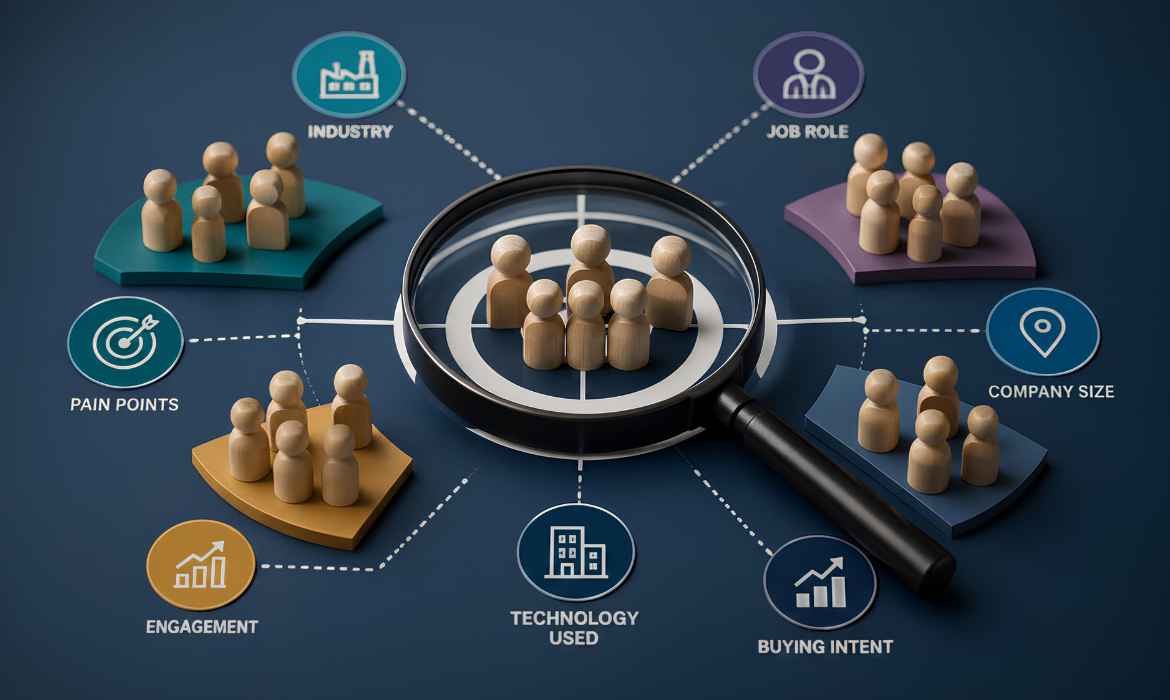
B2B audience targeting is the process of identifying and reaching the businesses, decision-makers, and buying groups most likely to need a specific product or service. Instead of showing the same message to a broad business audience, marketers use company information, job roles, technology usage, online behavior, business needs, and buying signals to create more relevant audience segments. This approach helps marketing teams focus their budget and content on prospects with stronger potential.
In 2026, B2B audience targeting has become more precise because buyers leave signals across many digital touchpoints. A prospect may read industry content, compare vendors, visit a product page, search for a solution, engage with an advertisement, or research a competitor before contacting a sales team. Modern targeting brings these signals together to understand not only who a potential buyer is, but also what they are interested in and when they may be ready to engage. This shift is moving B2B marketing away from broad reach and toward precision-driven engagement.
Why B2B Audience Targeting Matters in 2026
B2B buyers rarely follow a simple and predictable path. Multiple people can influence one purchase, and each stakeholder may have different priorities. A technology leader may care about integration, while a finance executive may focus on cost and business value. Procurement may concentrate on terms and risk. Therefore, targeting only one job title can leave important parts of the buying process uncovered.
B2B audience targeting helps marketers build a broader view of the buying group. It allows teams to identify the organizations that match their ideal customer profile and then understand the people and behaviors that influence the purchase. This is especially important as buying groups become more complex and customer journeys become less linear. Current B2B marketing research points toward more precise targeting based on accounts, roles, timing, intent, and observable engagement rather than simple impression volume.
Start With a Clear Ideal Customer Profile
A strong B2B audience targeting strategy starts with an ideal customer profile, or ICP. An ICP describes the type of organization that is most likely to benefit from your solution and become a valuable customer. It can include industry, company size, revenue range, location, business model, technology stack, growth stage, and other characteristics that separate strong-fit accounts from weak prospects.
The goal is not to create a profile that describes every company that could possibly buy from you. Instead, the ICP should help your team recognize the companies where your solution has the strongest potential. Historical customer data can provide valuable clues. Look at your best customers, their industries, company sizes, common challenges, purchase patterns, retention, and revenue contribution. These patterns can then shape your target audience and improve the accuracy of future campaigns.
Segment Your B2B Audience by Business Characteristics
Firmographic segmentation remains an important part of B2B audience targeting. It allows marketers to divide companies into meaningful groups using characteristics such as industry, employee count, annual revenue, geography, business model, and growth stage. For example, a B2B technology provider may create different segments for enterprise software companies, financial services firms, manufacturing businesses, and professional services organizations.
However, firmographics alone do not tell you whether a company is ready to buy. Two businesses can have almost identical profiles while being at completely different stages of the buying journey. One may be actively evaluating solutions, while the other may have no current requirement. Therefore, firmographic data should provide the foundation, while behavioral and intent signals add the timing and context needed for more effective targeting.
Target the Buying Committee, Not Just One Contact
B2B purchases often involve several stakeholders. The person researching a solution may not be the person who approves the budget. Similarly, the executive sponsor may not be the person who uses the product every day. This makes buying committee targeting increasingly important for B2B marketers.
A useful targeting strategy maps different roles within priority accounts. Marketing can then develop content that answers the concerns of each stakeholder. A technical audience may respond to product capabilities and integration information, while senior executives may want business outcomes, efficiency improvements, and financial impact. Reaching several relevant stakeholders also helps create stronger account engagement instead of depending on a single contact.
Use Intent Data to Identify Active Buyers
Intent data has become one of the most valuable layers of B2B audience targeting in 2026. Firmographic information can tell you which companies fit your target profile, but intent signals can indicate which companies are actively researching a category or solution. These signals may come from content consumption, searches, website behavior, product comparisons, and other research activity.
The real value comes from combining intent with customer fit. An account that matches your ICP and is also showing relevant research activity deserves more attention than an account that only matches your company criteria. This combination can help marketing teams prioritize campaigns and help sales teams focus their efforts on accounts with stronger buying signals. In practical terms, targeting becomes less about asking, “Who could buy?” and more about asking, “Who fits our business and appears to be moving toward a purchase?”
Bring First-Party Data Into Your Strategy
First-party data should play a central role in modern B2B audience targeting. This data comes directly from your own digital properties and business systems. Website visits, content downloads, email engagement, event registrations, CRM activity, demo requests, and previous interactions can reveal valuable information about audience interests.
First-party data also gives marketers greater control over audience understanding. Instead of depending entirely on external audience definitions, teams can build segments from known interactions with their brand. In 2026, first-party data is becoming increasingly important as marketers look for stronger data quality, better personalization, and more resilient targeting methods. B2B advertising research also highlights the growing role of first-party data in account-based targeting and personalization.
Add Technographic Data for Better Precision
Technographic data shows the technologies a company uses. This information can be highly useful when the product being marketed depends on an existing technology environment. For example, a cybersecurity company may want to identify businesses using specific cloud platforms, while a marketing technology provider may target organizations using particular CRM or automation systems.
When technographic information is combined with firmographic and behavioral data, marketers can create more meaningful audience segments. A company may fit the desired industry and revenue range, but if it does not use the technology required for your solution, it may not be an ideal prospect. Technographic targeting helps remove some of that uncertainty and gives campaigns more relevant context.
Use AI to Improve Audience Targeting
Artificial intelligence is changing how marketers analyze and activate audience data. Instead of manually reviewing thousands of accounts and interactions, AI can identify patterns across firmographic, behavioral, technographic, and intent data. It can help marketers recognize high-potential accounts, prioritize segments, and identify changes in buyer behavior.
AI is also being used to improve personalization and account scoring. Recent 2026 research shows that AI is increasingly being applied to account scoring, targeting, personalization, and campaign optimization. However, technology alone does not create a strong targeting strategy. Teams still need reliable data, clear business objectives, appropriate segmentation, and human judgment to make sure automated recommendations support the actual go-to-market strategy.
Create Dynamic Audience Segments
Traditional audience lists can become outdated quickly. A company that looked like a good prospect six months ago may have changed its priorities, technology stack, leadership, or budget. At the same time, an account that previously showed little interest may suddenly enter an active buying cycle.
Dynamic segmentation helps marketers respond to these changes. Audience membership can change when new intent signals, engagement activity, account information, or business events appear. This makes B2B audience targeting more responsive to real buyer behavior. Instead of rebuilding target lists manually every quarter, teams can create audience rules that adjust as new information becomes available.
Personalize Content Around Buyer Needs
Targeting and personalization should work together. Identifying the right audience is only the first step. The next challenge is giving that audience a reason to pay attention. Generic content can struggle when prospects already have access to a large amount of information.
Effective personalization does not always mean creating a completely different campaign for every individual. It can mean adapting the message to the industry, account type, role, buying stage, or business challenge. For example, an enterprise audience may receive content focused on scalability and risk, while a mid-market audience may see messaging focused on efficiency and speed. AI can help create variations at scale, but human review remains important for maintaining relevance, accuracy, and brand quality.
Connect Targeting Across Multiple Channels
B2B buyers move between channels during research, so audience targeting should not operate inside one channel. A target account may discover your brand through search, read an article, interact with LinkedIn content, attend a webinar, visit your website, and later speak with sales. Each interaction provides additional context.
A connected strategy allows marketing teams to coordinate these experiences. Paid advertising can support awareness, content can answer research questions, email can nurture engagement, and sales outreach can respond to stronger buying signals. When these activities share audience information, the buyer receives a more consistent experience. This also helps marketers understand how different channels contribute to account engagement instead of evaluating every channel separately.
Measure B2B Audience Targeting by Business Impact
Audience targeting should ultimately connect to business outcomes. Reach, impressions, clicks, and engagement can provide useful information, but they do not tell the complete story. B2B marketers should also track account engagement, qualified opportunities, pipeline contribution, conversion rates, sales cycle movement, customer acquisition cost, and revenue.
The right metrics depend on the campaign objective. An awareness campaign may focus on qualified account reach and engagement, while a demand generation campaign may prioritize opportunities and pipeline. Account-based programs can also measure engagement across multiple stakeholders within target organizations. This approach gives marketing and sales teams a clearer picture of whether targeting is attracting the right businesses rather than simply generating more activity.
Avoid Common B2B Targeting Problems
One common problem is making the audience too broad. A large audience can create impressive reach, but it may also waste budget on businesses that have little connection to your offering. Another issue is relying too heavily on job titles. Titles vary across organizations, and the person with the right title may not have any influence over the purchase.
Data quality is another major concern. Outdated company information, duplicate records, incorrect job roles, and incomplete account details can reduce campaign performance. Teams should regularly clean and validate their audience data. They should also compare targeting assumptions with actual campaign and sales results. When the data shows that certain segments consistently perform better, those insights should feed back into the targeting strategy.
Build a More Precise B2B Audience Targeting Framework
A practical framework can bring these elements together. Begin with your ICP and identify the accounts that represent the strongest fit. Next, enrich those accounts with firmographic and technographic information. Then identify relevant decision-makers and members of the buying committee. Add first-party engagement and external intent signals to understand which accounts are active.
The next stage is activation. Assign audiences to relevant campaigns, personalize messaging based on account and buyer context, and connect marketing activity with sales follow-up. AI can support scoring, prioritization, personalization, and analysis throughout the process. Finally, measure account engagement, qualified opportunities, pipeline, and revenue to understand what is working. This creates a continuous targeting process rather than a one-time audience-building exercise.
The Future of B2B Audience Targeting
B2B audience targeting is moving toward a model that combines account intelligence, buyer behavior, intent signals, AI, and real-time activation. Static personas still have value, but they are no longer enough to explain complex B2B buying journeys. Modern marketers need to understand both the organization and the people involved in the decision.
The strongest strategies will focus on relevance rather than maximum reach. They will identify the accounts that matter, recognize when those accounts show meaningful buying signals, understand the stakeholders involved, and deliver useful information at the right stage. As AI becomes more deeply integrated into B2B marketing, the competitive advantage will come from combining better data with better judgment and more relevant experiences. Current 2026 research also points to this broader shift toward AI-assisted targeting, intent-driven engagement, buying-group intelligence, and privacy-conscious use of first-party data.
Take Your B2B Audience Targeting to the Next Level
A precise audience strategy can help your business reach the right accounts, engage relevant decision-makers, and create stronger opportunities across the buying journey. At Acceligize, we help B2B businesses connect data, audience intelligence, content, and demand generation to create more effective marketing programs. Visit Acceligize to explore how our B2B marketing solutions can help you reach high-value audiences and accelerate pipeline growth.
What is B2B audience targeting?
B2B audience targeting is the process of identifying and reaching businesses, decision-makers, and buying groups that are most likely to need a product or service.
What data is used for B2B audience targeting?
B2B marketers can use firmographic, technographic, behavioral, first-party, and intent data to identify relevant accounts and understand their interests and buying activity.
How can businesses improve B2B audience targeting?
Businesses can improve targeting by defining a clear ICP, segmenting accounts, identifying buying-group members, using relevant intent signals, and continuously updating audience data.
How do you measure B2B audience targeting success?
Success can be measured through qualified account engagement, conversion rates, opportunity creation, pipeline contribution, customer acquisition cost, and revenue from target accounts.