

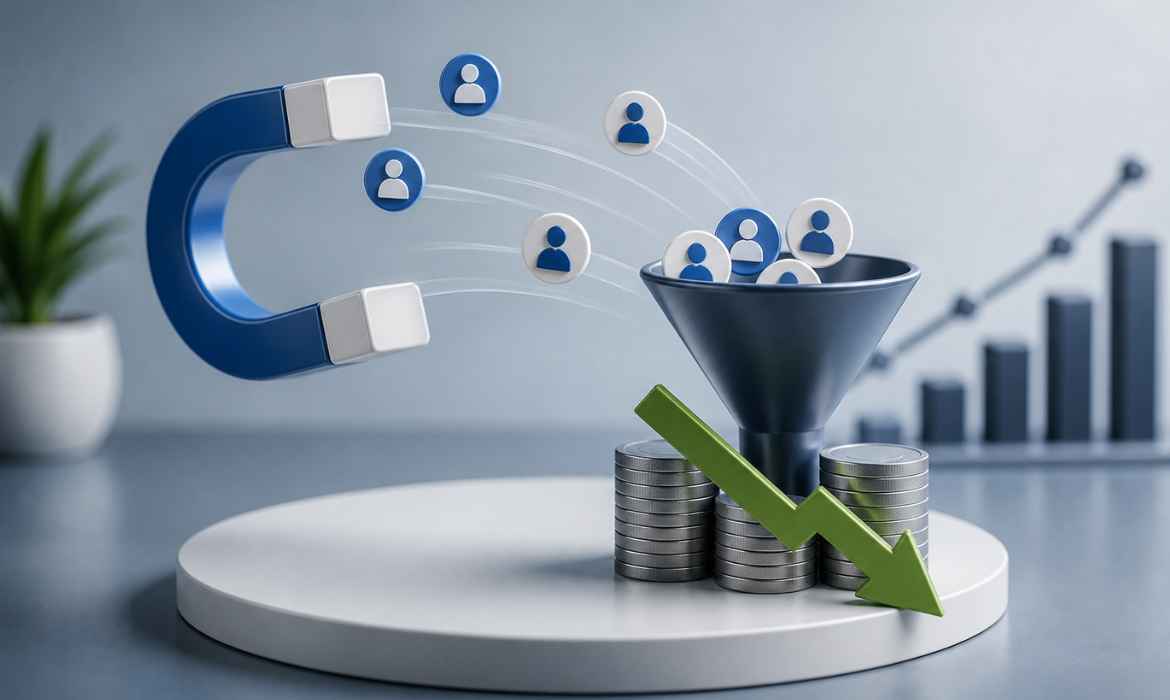
Growing a B2B business is not simply about generating more leads. It is about generating the right leads and converting them into customers without continuously increasing marketing and sales spending. This is where customer acquisition cost becomes an important business metric. When acquisition costs rise, companies often respond by increasing budgets, adding more channels, or pushing sales teams to work harder. However, these actions may not solve the real problem. In many cases, the issue is not a lack of spending but inefficient demand generation.
A smarter demand generation strategy helps businesses reach relevant prospects earlier, build awareness, create meaningful engagement, and guide buyers toward a purchase decision. Instead of depending heavily on paid campaigns or high-volume lead generation, businesses can combine valuable content, accurate targeting, buyer intent data, personalization, and strong marketing and sales alignment. This approach can help lower customer acquisition cost while improving the overall quality of the sales pipeline.
What Is Customer Acquisition Cost?
Customer acquisition cost refers to the total amount a business spends to acquire a new customer. It can include marketing expenses, advertising costs, sales salaries, technology, content production, events, agencies, data services, and other acquisition-related expenses. A basic calculation divides total sales and marketing costs for a specific period by the number of new customers acquired during that period.
For example, if a company spends $100,000 on sales and marketing in a quarter and acquires 50 new customers, its customer acquisition cost is $2,000 per customer. However, the number becomes more useful when businesses examine it alongside customer lifetime value, sales cycle length, conversion rates, and revenue generated. A low acquisition cost does not automatically mean a healthy business if customers generate little revenue or leave quickly.
For B2B organizations, measuring customer acquisition cost can be more complex because buying decisions often involve several stakeholders and longer sales cycles. A prospect may interact with a blog, attend a webinar, download a report, speak with an SDR, join a product demonstration, and engage with multiple emails before becoming a customer. Therefore, companies need a complete view of acquisition activity rather than focusing only on individual campaign costs.
Why Customer Acquisition Cost Can Increase
Several factors can push customer acquisition cost higher. One common reason is poor audience targeting. When campaigns reach people who do not match the ideal customer profile, marketing teams pay for impressions, clicks, downloads, and leads that have little chance of becoming customers. As a result, sales teams spend more time qualifying prospects while conversion rates remain low.
Another issue is excessive dependence on expensive paid channels. Paid advertising can generate fast visibility, but costs can increase as competition grows. If a business relies on paid campaigns for most of its pipeline, rising cost per click and declining conversion rates can directly affect customer acquisition cost.
Weak alignment between marketing and sales can also increase acquisition costs. Marketing may focus on generating large numbers of leads while sales focuses on closing accounts with strong buying potential. Without shared definitions, data, and goals, teams may spend resources on prospects who are not ready to buy. Smarter demand generation addresses this gap by connecting awareness, engagement, qualification, and sales activity.
Build Demand Before Asking for the Sale
One of the most effective ways to control customer acquisition cost is to build demand before asking prospects to make a purchase. B2B buyers usually conduct significant research before speaking with a sales representative. They compare solutions, study industry trends, evaluate vendors, and look for answers to specific business problems.
Businesses can support this research process through useful content such as industry reports, expert articles, comparison guides, research-based insights, webinars, case studies, and educational resources. When content answers real buyer questions, it can attract relevant prospects without requiring a sales conversation at the first interaction.
This approach also creates a long-term acquisition asset. A useful article can continue attracting organic traffic after publication, while a strong research report can support campaigns across email, social media, sales outreach, and account-based marketing. Therefore, content can contribute to lower customer acquisition cost by creating multiple opportunities from a single investment.
Google also recommends creating helpful, reliable, people-first content rather than content designed primarily to manipulate search rankings.
Focus on the Right Audience
Better targeting can have a direct impact on customer acquisition cost. Instead of attempting to reach the largest possible audience, B2B marketers should identify the companies and decision-makers most likely to benefit from their solution.
An ideal customer profile can help define factors such as company size, industry, geography, technology environment, business challenges, buying authority, and potential revenue value. Once these characteristics are clear, marketing teams can build campaigns around accounts that have a stronger chance of becoming customers.
Audience segmentation can make this approach even more effective. Different industries may have different pain points, while executives and operational buyers may care about different outcomes. Personalized campaigns can therefore make messages more relevant and reduce wasted marketing activity.
When the right audience receives the right message, businesses can improve engagement and lead quality. This can reduce the number of low-value leads entering the funnel and help sales representatives spend more time with prospects who have genuine potential.
Use Buyer Intent Data to Prioritize Demand
Not every prospect who visits a website is ready to buy. Some visitors may be researching a topic, while others may already be evaluating vendors. Buyer intent data can help businesses identify these differences.
Intent signals can include repeated visits to product pages, engagement with specific content, searches around relevant topics, webinar participation, increased activity from a target account, or interactions with pricing and solution information. When these signals are combined with account and contact data, marketers can identify prospects who may be moving closer to a buying decision.
Prioritizing these accounts can improve the efficiency of demand generation. Instead of treating every lead equally, marketing and sales teams can focus resources on prospects showing meaningful interest. This can help reduce customer acquisition cost because more effort is directed toward accounts with stronger purchase potential.
Intent data should not be treated as a guarantee that someone will buy. Instead, it should be used as one part of a broader qualification process. Businesses should combine intent with firmographic information, engagement history, lead quality, and sales feedback.
Improve Lead Quality Instead of Chasing Lead Volume
A large number of leads can create an impressive marketing report, but lead volume alone does not determine business growth. If most leads never become qualified opportunities, acquisition spending can rise without producing proportional revenue.
Smarter demand generation focuses on lead quality. Marketing teams can establish qualification criteria based on the company’s ideal customer profile, buying stage, business needs, engagement, and potential account value. This helps create a clearer connection between marketing activity and sales outcomes.
For example, a campaign that produces 1,000 low-quality leads may look stronger than a campaign that generates 150 highly relevant prospects. However, if the second campaign creates more sales opportunities and customers, it may deliver a much better customer acquisition cost.
This is why businesses should measure metrics beyond leads. Marketing teams should monitor qualified opportunities, opportunity-to-customer conversion, pipeline value, revenue contribution, and acquisition cost by channel. These metrics provide a clearer picture of which demand generation activities actually support growth.
Strengthen Content Distribution
Creating good content is only one part of demand generation. Businesses also need a distribution strategy that puts that content in front of the right audience.
A single piece of content can be adapted into several formats. A research report can become a webinar topic, LinkedIn posts, email content, sales enablement material, short videos, and supporting website content. This increases the value generated from the original investment.
Organic search is another important distribution channel. When content addresses relevant search intent and provides useful information, it can attract prospects who are actively researching problems related to the company’s solution. Over time, this can create a sustainable source of demand and reduce dependence on paid acquisition.
However, businesses should not create content simply to target keywords. Google emphasizes that content should provide substantial value, demonstrate expertise, and satisfy the needs of the intended audience.
Personalize Demand Generation at Scale
B2B buyers expect relevant communication. Generic messages can make prospects feel like they are part of a mass campaign rather than a meaningful business conversation.
Personalization can be applied across email, website experiences, advertising, content recommendations, and sales outreach. A technology company, for example, may respond differently to a CIO researching infrastructure modernization than to a marketing leader evaluating demand generation solutions.
Modern data and automation platforms make this personalization more scalable. Businesses can create audience segments, identify behavioral signals, recommend relevant content, and trigger follow-up activities based on prospect engagement.
The objective is not to personalize every sentence. The objective is to make the experience more relevant. When prospects receive information that matches their industry, role, business challenge, and buying stage, engagement can improve while unnecessary outreach can decline. This can contribute to a more efficient customer acquisition cost.
Connect Marketing and Sales Data
Disconnected systems can make it difficult to understand where acquisition money is being spent and what it produces. Marketing platforms, CRM systems, advertising tools, intent platforms, and sales engagement systems often contain valuable information, but that information needs to work together.
A unified view helps businesses understand the customer journey from first interaction to closed revenue. Marketing can see which campaigns generate qualified opportunities, while sales can see the content and activities that influenced an account.
This also makes customer acquisition cost easier to analyze by channel. Instead of asking how many leads a campaign generated, businesses can ask how many customers it influenced and how much revenue it helped create.
Revenue-focused reporting can reveal that an expensive channel may still be valuable if it consistently produces high-value customers. Likewise, a low-cost channel may not be efficient if the leads rarely convert. This is why acquisition decisions should be based on business outcomes rather than surface-level metrics.
Use Account-Based Demand Generation
For companies selling complex B2B solutions, account-based marketing can improve acquisition efficiency by focusing resources on selected high-value accounts.
Rather than launching broad campaigns for thousands of companies, teams can identify a defined group of target accounts and develop messaging around their specific challenges. Marketing can then coordinate advertising, content, events, email, sales outreach, and executive engagement around those accounts.
Account-based demand generation can help reduce wasted activity because the strategy begins with account selection. It also gives sales teams a clearer understanding of which organizations marketing is actively supporting.
The approach works particularly well when the potential value of each customer is high. A business may be able to justify a more personalized acquisition process when one new account can generate substantial long-term revenue.
Optimize Conversion Points Across the Buyer Journey
Reducing customer acquisition cost is not only about generating cheaper traffic. It is also about converting more of the traffic and engagement a company already receives.
Businesses should review important conversion points across the buyer journey. Website forms, landing pages, demo requests, content downloads, webinar registrations, email sequences, and sales handoffs can all create friction.
Small improvements can have a meaningful impact. A clearer value proposition, simpler form, stronger call to action, relevant proof point, or better follow-up process can improve conversion without requiring additional advertising spend.
For example, if 10,000 visitors generate 100 qualified opportunities, improving the conversion process can create more opportunities from the same traffic volume. This means the original marketing investment produces greater value, which can improve customer acquisition cost.
Reduce Customer Acquisition Cost with Better Lead Nurturing
Many B2B prospects are interested but not ready to buy immediately. If businesses treat every non-ready prospect as a lost lead, they may continue spending money to replace the same audience repeatedly.
Lead nurturing provides another option. Businesses can maintain relevant communication through educational content, industry insights, case studies, webinars, product information, and timely sales follow-ups.
The goal is to stay useful without overwhelming the prospect. A strong nurturing strategy can help move prospects from awareness to consideration and eventually toward a sales conversation.
This can lower customer acquisition cost because businesses get more value from leads they have already acquired. Instead of continuously paying to find new prospects, companies can develop existing relationships until the timing becomes right.
Measure Customer Acquisition Cost by Channel
Blended customer acquisition cost provides a useful overall picture, but channel-level analysis can reveal where improvements are needed. Businesses can compare acquisition performance across paid search, organic search, email, events, social media, webinars, partner programs, outbound campaigns, and other channels.
However, channel analysis should account for the complete buyer journey. A prospect may discover a company through organic search, engage with an email campaign, attend a webinar, and later convert through a sales conversation. Giving all credit to the final interaction can lead to incorrect budget decisions.
Businesses should therefore examine assisted conversions, influenced pipeline, customer quality, sales cycle length, and revenue alongside direct attribution. This creates a more balanced understanding of customer acquisition cost.
Automate Repetitive Demand Generation Activities
Automation can help marketing teams spend more time on strategy and less time on repetitive work. Lead routing, campaign workflows, email nurturing, data enrichment, audience segmentation, reporting, and follow-up processes can often be automated when the right systems are in place.
Automation does not replace strategic thinking. Instead, it allows teams to execute consistent processes at scale. It can also reduce delays between prospect activity and sales follow-up.
For example, when a high-value account shows increased engagement, an automated workflow can update the CRM, alert the relevant sales representative, and provide the representative with useful account information. Faster and more relevant action can improve the chance of conversion while helping control customer acquisition cost.
Make Demand Generation a Revenue Function
The most important shift is to stop treating demand generation as a collection of campaigns and start treating it as a revenue function. Every major activity should have a clear relationship with business outcomes.
Marketing teams should know which audiences they are targeting, which problems they are addressing, which channels they are using, how prospects are engaging, and how those engagements contribute to pipeline and revenue.
Sales teams should also be part of the process. Their feedback can help marketing understand common objections, changing buyer needs, account quality, and reasons opportunities are won or lost.
When both teams operate from shared data and goals, businesses can make smarter investment decisions. They can reduce activities that produce little value, strengthen channels that create qualified demand, and improve the efficiency of every stage of the acquisition journey.
Build a Smarter Path to Lower Customer Acquisition Cost
Lowering customer acquisition cost does not always require cutting the marketing budget. In many cases, it requires making the existing budget work harder. Better targeting, useful content, buyer intent signals, personalized engagement, lead nurturing, conversion optimization, and marketing and sales alignment can all improve acquisition efficiency.
The strongest demand generation strategies focus on relevance rather than volume. They help businesses reach prospects who fit their ideal customer profile, provide useful information throughout the buying journey, and create a smoother path from initial interest to revenue.
As B2B buying journeys become more complex, businesses need a more connected approach to demand generation. The companies that understand their audiences, use data intelligently, create valuable experiences, and measure performance against revenue will be better positioned to manage customer acquisition cost while building sustainable growth.
Drive More Efficient B2B Growth with Acceligize
Looking to improve your B2B demand generation, reach high-value prospects, and build a more efficient path from engagement to revenue? Acceligize helps businesses strengthen their B2B marketing and lead generation efforts with data-driven solutions designed to connect businesses with relevant audiences and create meaningful demand. Explore Acceligize to discover smarter ways to improve your demand generation strategy and accelerate B2B growth.
What is customer acquisition cost in B2B marketing?
Customer acquisition cost is the total sales and marketing cost required to acquire a new customer. It can include advertising, sales, content, technology, events, and other acquisition expenses.
How can demand generation reduce customer acquisition cost?
Smarter demand generation can reduce acquisition cost by improving audience targeting, lead quality, content engagement, conversion rates, and the efficiency of marketing and sales activities.
How does intent data help lower customer acquisition cost?
Intent data helps identify accounts showing relevant buying activity. This allows marketing and sales teams to focus resources on prospects with stronger purchase potential instead of treating every lead equally.
Which metrics should businesses track to measure CAC efficiency?
Businesses should track customer acquisition cost alongside qualified opportunities, conversion rates, pipeline value, customer quality, sales cycle length, and revenue contribution to understand acquisition efficiency.