

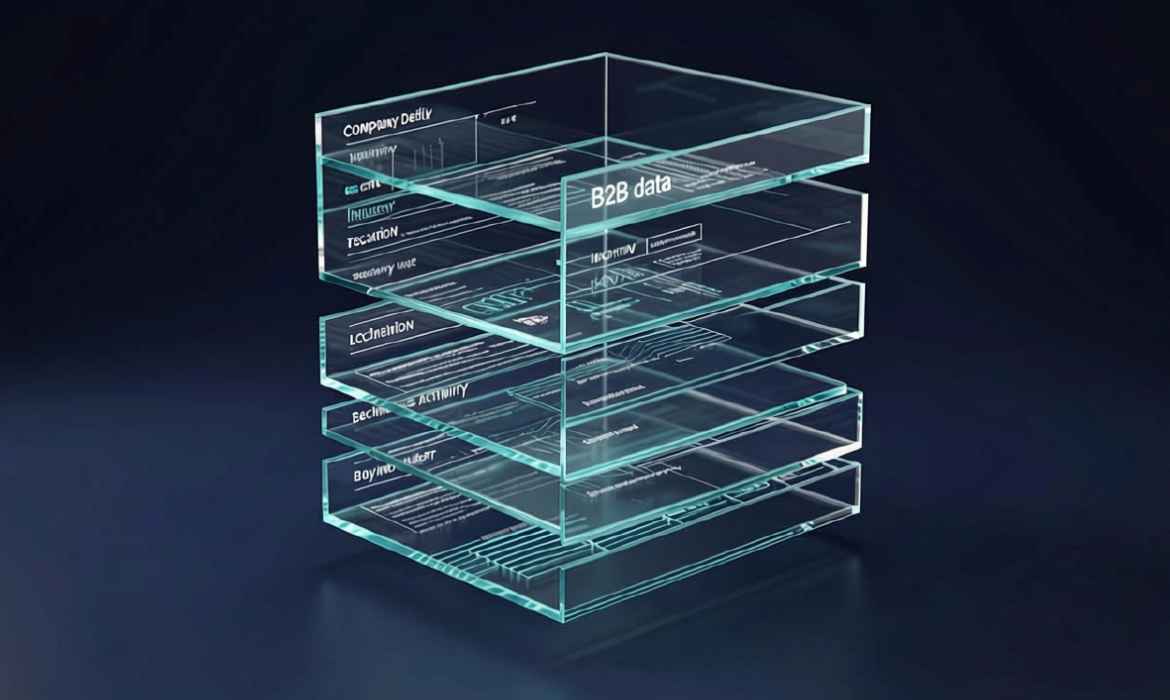
A large B2B database can look impressive. Thousands of names, companies, email addresses, and job titles may give your marketing and sales teams the impression that they have everything needed to generate leads.
However, the real situation can be very different.
Some contacts may have changed jobs. Company information may be outdated. Job titles may no longer be accurate, while important details such as employee count, industry, revenue, location, or technology usage may be missing. Duplicate records can also make the database harder to manage.
This creates a common problem for B2B teams. The challenge is not always finding more contacts. It is making sure the contacts already in the database contain enough accurate information to support better decisions.
This is where B2B data enrichment becomes important.
Data enrichment helps businesses add useful information to existing prospect and company records. Instead of relying on basic contact details, teams can build a more complete picture of the businesses and people they want to reach.
For B2B lead generation, that additional context can make prospecting more focused, qualification more accurate, and outreach more relevant.
What B2B Data Enrichment Really Adds
Consider a basic CRM record that contains only a person’s name, job title, company, and email address.
That information is useful, but it provides limited context.
Now imagine the same record includes the company’s industry, employee count, revenue range, location, business model, technology environment, and recent business activity. The contact’s department, seniority, professional role, and relationship with the buying process are also available.
The second record gives the sales team a much clearer understanding of the prospect.
This is the purpose of B2B data enrichment. It adds relevant information to existing records so marketing and sales teams can better understand accounts and prospects.
The information added depends on the company’s goals. A technology provider may need technology usage data, while a demand generation company may be more interested in company size, marketing team structure, revenue, and business growth.
The objective is not to collect every available data point.
Instead, the goal is to collect information that helps teams decide which companies to target, which people to contact, how to personalize communication, and which prospects deserve greater attention.
From a Basic Contact to a Complete Prospect Profile
A contact record rarely tells the complete story of a potential customer.
For example, knowing that someone is a Marketing Director at a technology company gives a salesperson a starting point. It does not necessarily explain whether the company matches the target market, how large the marketing operation is, what technologies it uses, or whether there is a current business reason to consider a new solution.
Enrichment brings additional context into the record.
Company information can help determine whether an organization matches the Ideal Customer Profile. Professional information can help identify decision-makers and influencers. Business and behavioral information can provide further context about what may be happening within the account.
This creates a more useful prospect profile.
It can also reduce the amount of manual research required from sales representatives. When basic account research is already available, sales professionals can spend more time preparing for conversations and less time searching for information that should already exist in the CRM.
Where B2B Enriched Data Comes From
B2B data enrichment can use information from several different sources. The quality of the final data depends on the accuracy, reliability, and freshness of those sources.
First-party data is one important source. This can include information collected through websites, forms, CRM activity, marketing campaigns, customer interactions, webinars, and events. Since this information comes from your own business activities, it can provide valuable context about prospects and customers.
Public business information can provide another layer. Company websites, business announcements, professional information, and other publicly available sources can help identify changes in leadership, company structure, locations, or business activities.
Third-party data providers can also help businesses enrich large databases. Depending on the provider, information may include company details, professional data, technology information, and other relevant account characteristics.
Behavioral and intent signals can provide additional context. Website visits, content engagement, research activity, and other signals can help teams understand what a company may currently be interested in.
The important thing is to evaluate the usefulness of each source rather than simply collecting information from as many sources as possible.
The Data Points That Actually Matter for Lead Generation
Not every piece of information has the same value.
For B2B lead generation, company-level data is often the starting point. Industry, employee count, revenue, location, company size, and business model can help determine whether an organization fits the target market.
Professional information provides another layer. Job title, seniority, department, responsibilities, and decision-making influence can help teams identify the people who should receive marketing or sales attention.
Technology information can also be valuable. Understanding the tools and platforms used by an organization can help determine whether a company’s existing environment aligns with your product or service.
Then there are business and behavioral signals. Hiring activity, expansion, leadership changes, content engagement, website activity, and other relevant events can provide useful context.
The right data depends on your audience.
A cybersecurity provider may need to understand a company’s technology environment. A B2B lead generation company may focus more on sales team size, marketing maturity, revenue growth, and demand generation requirements.
The best enrichment strategy is therefore built around the questions your marketing and sales teams need to answer.
How B2B Data Enrichment Fits Into Lead Generation
Data enrichment can influence the lead generation process from the moment a target account is identified.
Marketing teams can use enriched company information to determine which businesses fit their Ideal Customer Profile. Instead of targeting a broad industry, they can create more precise account segments based on company characteristics.
The next step is identifying relevant people within those accounts.
Professional information can help marketers and sales teams find executives, managers, and other stakeholders who may influence the buying process. This becomes particularly important for B2B purchases where multiple people are involved in a decision.
Enrichment can also support lead qualification.
A contact may initially appear relevant because of their job title. However, additional company information may reveal that the business is too small, operates in an unsuitable market, or does not meet other qualification criteria.
The opposite can also happen.
A contact who initially appears to be an ordinary prospect may work for a company that has recently expanded, increased its workforce, entered a new market, or changed its technology environment. That additional information can make the account much more interesting to the sales team.
During outreach, enriched information can also support personalization. Sales representatives can understand the prospect’s business context before starting a conversation instead of relying on generic messaging.
A Realistic Example of B2B Data Enrichment in Action
Imagine a B2B company that provides marketing technology solutions.
Its CRM contains 10,000 contacts. However, many records include only names, email addresses, company names, and job titles.
The marketing team wants to target organizations with established marketing departments and growing sales operations. The existing database does not provide enough information to create that audience accurately.
The company enriches its records with employee count, industry, revenue range, location, department, seniority, technology usage, and other relevant company characteristics.
The marketing team can now identify accounts that closely match its target market. Sales representatives can also identify the right decision-makers within those organizations.
The campaign does not become more effective simply because more fields have been added to the database.
It becomes more effective because the additional information helps the team make better decisions.
Instead of asking, “Who can we contact?” the team can ask, “Which accounts fit our strategy, who should we reach, and what makes this account relevant?”
That is where enriched data becomes useful.
Data Quality Matters More Than Data Volume
A common mistake in B2B marketing is assuming that a larger database automatically creates better results.
It does not.
A database containing 100,000 outdated records can be less valuable than a smaller database containing accurate and relevant information.
Job changes are one obvious example. A person may have been the right decision-maker when a record was created but may have moved to another company months later. If the information is not updated, sales representatives may waste time contacting the wrong person.
Duplicate records can create another problem. The same contact may appear several times because of different email addresses, company names, or data sources. This can affect campaign reporting and create a poor prospect experience.
Companies also change constantly. They merge with other businesses, acquire organizations, expand into new markets, change locations, and restructure departments.
Therefore, B2B data enrichment should work alongside data validation and data cleansing. Adding information to an inaccurate record does not solve the underlying data quality problem.
Making B2B Data Enrichment Part of an Ongoing Strategy
B2B data does not remain accurate forever.
People change jobs. Companies grow. Departments are reorganized. Technologies change. Business priorities shift.
For that reason, enrichment should not be treated as a one-time database cleanup project.
A stronger approach is to make data quality an ongoing part of marketing and sales operations. New contacts can be enriched as they enter the CRM, while existing records can be reviewed and updated based on their importance and activity.
High-value target accounts may require more frequent attention because outdated information can have a greater impact on account-based campaigns and sales outreach.
It is also useful to establish clear standards for the information required before a prospect is considered ready for outreach. This helps prevent sales teams from receiving incomplete records and having to conduct the same research repeatedly.
When enrichment becomes part of the normal workflow, the CRM becomes more than a contact storage system. It becomes a more reliable source of prospect intelligence.
How Better Data Leads to Better B2B Conversations
The purpose of B2B data enrichment is not to create a larger spreadsheet.
It is to help teams make better decisions.
When marketing understands which companies match the target profile, campaigns can become more focused. When sales knows who the relevant decision-makers are, prospecting becomes more efficient.
Better data can also support more natural personalization.
A sales representative who understands a company’s industry, size, business model, technology environment, and recent developments has a stronger foundation for starting a conversation than someone working with only a name and email address.
The same principle applies to marketing. Content can be adapted to different industries, company segments, roles, and stages of the buying journey when audience information is accurate.
Over time, these improvements can support stronger lead qualification, more productive sales conversations, and better pipeline quality.
Turn Better Data Into Better B2B Opportunities with Acceligize
Acceligize helps B2B businesses connect accurate audience data with targeted lead generation strategies. Through B2B lead generation, demand generation, account-based marketing, appointment setting, and data-driven audience targeting, Acceligize helps businesses reach relevant companies and decision-makers.
If your database contains incomplete records, outdated contacts, or prospects without enough information for effective qualification, simply adding more leads may not solve the problem.
Build a stronger data foundation and turn your target accounts into qualified conversations with Acceligize.
What is B2B data enrichment?
B2B data enrichment adds relevant company, contact, professional, technology, and behavioral information to existing records so marketing and sales teams can better understand and qualify prospects.
What types of data can be used for enrichment?
Businesses can enrich records with firmographic, professional, technographic, behavioral, business, and intent data. The right data depends on the questions sales and marketing teams need to answer.
How does data enrichment improve B2B lead generation?
It helps teams identify accounts that fit their target market, find relevant decision-makers, improve lead qualification, and personalize outreach using more complete prospect information.
Why is data quality important for B2B enrichment?
Accurate and fresh data helps teams avoid outdated contacts, duplicate records, and incomplete profiles. Regular validation and enrichment make CRM data more reliable for marketing and sales decisions.