


A successful B2B marketing strategy needs more than regular social media posts, email campaigns, and website updates. Businesses need a clear direction that connects marketing activities with sales objectives and revenue growth. This is where a B2B marketing plan becomes important. It helps marketing teams understand which audiences they should target, what messages they should communicate, which channels they should use, and how they will measure results.
Unlike B2C marketing, B2B marketing often involves longer buying cycles, multiple decision-makers, and detailed purchasing evaluations. Therefore, businesses need a structured approach to reach potential buyers and build relationships throughout their decision-making process. A well-organized plan provides that direction while helping teams use their time and resources effectively.
In this guide, we will explore how to create a B2B marketing plan, the important steps involved, and practical examples that businesses can use to organize their marketing activities.
What Is a B2B Marketing Plan?
A B2B marketing plan is a documented roadmap that explains how a business will promote its products or services to other businesses. It outlines marketing objectives, target accounts, buyer personas, positioning, promotional channels, budgets, timelines, and performance indicators.
The main purpose is to connect marketing activities with measurable business outcomes. Instead of running campaigns without a defined direction, marketing teams can prioritize activities that attract relevant prospects, generate qualified leads, and support the sales pipeline.
For example, a company offering business consulting services might focus on reaching decision-makers in mid-sized organizations. Its marketing activities could include industry-specific blogs, LinkedIn campaigns, email outreach, and downloadable research reports.
Each activity supports a common objective: attracting businesses that are more likely to become customers.
Why Is a B2B Marketing Plan Important?
A structured marketing plan helps businesses maintain consistency across different campaigns and marketing channels. It also gives marketing and sales teams a shared understanding of their priorities.
Without a documented approach, companies may invest in several marketing activities without knowing which ones contribute to meaningful business results.
Here are some important benefits:
- Better audience targeting: Teams can focus on industries, companies, and decision-makers that match their ideal customer profile.
- Improved resource allocation: Marketing budgets and team resources can be distributed according to business priorities.
- Stronger sales alignment: Marketing and sales teams can agree on lead qualification, follow-up processes, and pipeline objectives.
- Consistent communication: Businesses can maintain relevant messaging across email, content, advertising, and other channels.
- Measurable performance: Defined KPIs help teams understand campaign effectiveness and identify areas for improvement.
These benefits make planning an important part of long-term B2B demand generation.
How to Create a B2B Marketing Plan Step by Step
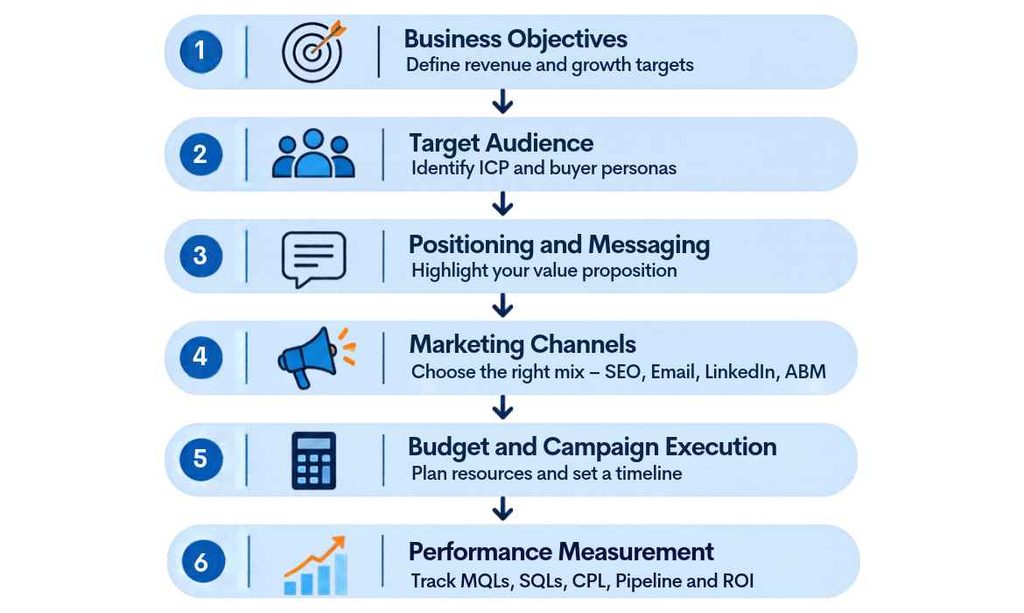
Creating an effective B2B marketing plan requires a clear understanding of business objectives, customer requirements, and available resources. The following steps provide a practical framework that marketing teams can follow.
1. Analyze Your Current Marketing Position
Before planning new activities, review your existing marketing performance. Understand which campaigns have generated engagement, which channels have attracted qualified prospects, and where potential customers are dropping out of the buying journey.
Start by examining website traffic, lead generation reports, conversion rates, customer acquisition data, and previous campaign results. Competitor research can also reveal opportunities to improve your market positioning.
A SWOT analysis can help organize these findings by identifying strengths, weaknesses, opportunities, and threats. This gives your team a realistic starting point instead of building a plan around assumptions.
2. Define Your Marketing Goals and Objectives
Every B2B marketing plan should begin with measurable objectives. These goals should support broader business priorities, such as increasing qualified leads, expanding into new industries, improving brand visibility, or contributing to sales pipeline growth.
Use the SMART framework to make your objectives specific, measurable, achievable, relevant, and time-bound.
For example, instead of setting a general goal to generate more leads, a business could aim to increase marketing-qualified leads by 20% within six months while improving the MQL-to-SQL conversion rate.
Your objectives should also include clear KPIs. This allows marketing teams to evaluate progress and understand whether their activities are delivering the expected results.
3. Identify Your Ideal Customer Profile and Buyer Personas
Understanding your audience is one of the most important parts of B2B marketing planning. Businesses should identify the types of organizations that are most likely to benefit from their offerings.
An Ideal Customer Profile (ICP) describes the characteristics of suitable companies. It may include industry, company size, annual revenue, location, technology usage, and business requirements.
Buyer personas provide additional information about the individuals involved in purchasing decisions. These may include marketing directors, sales leaders, procurement managers, and other senior decision-makers.
For example, a company providing lead generation services might target technology firms, professional service providers, and enterprise organizations looking to improve their sales pipeline. Its messaging should address the specific challenges faced by each audience segment.
4. Develop Your Positioning and Marketing Message
Once you understand your target audience, define how your business should communicate its value. Your positioning should explain what problems you solve, who benefits from your solution, and why potential customers should consider your business.
Avoid using generic statements that could describe almost any company. Instead, focus on relevant business challenges, practical benefits, and clear differentiators.
For instance, a B2B demand generation company could position its services around helping organizations reach relevant decision-makers, improve lead quality, and support sales pipeline development.
Maintain consistent messaging across your website, email campaigns, landing pages, social media, and other communication channels. This makes it easier for prospects to understand your offering at different stages of their buying journey.
5. Select the Right B2B Marketing Channels
Not every marketing channel delivers the same results for every business. Your channel selection should depend on your target audience, campaign objectives, available budget, and buying process.
Some commonly used B2B marketing channels include:
- Content marketing and SEO: Publish educational blogs, industry reports, guides, and case studies to attract buyers researching business solutions.
- LinkedIn marketing: Reach professionals, business leaders, and relevant decision-makers through organic content and targeted campaigns.
- Email marketing: Share useful information, nurture prospects, and maintain communication with potential customers.
- Account-based marketing: Focus marketing and sales activities on selected high-value accounts and their buying groups.
- Paid advertising: Use search and professional networking platforms to reach specific business audiences.
- Content syndication: Distribute relevant content through external publishing networks to expand audience reach and generate potential leads.
Choose channels based on their relevance to your audience rather than trying to maintain a presence everywhere. A focused approach makes campaign execution and performance tracking more manageable.
6. Create a Marketing Budget and Allocate Resources
A marketing plan needs a realistic budget to support its execution. Estimate the investment required for content production, advertising, marketing technology, email campaigns, events, and external services.
Your budget should reflect business priorities and the expected contribution of each activity. For example, a company focused on organic growth may allocate more resources to SEO and content development, while a business entering a new market may invest in targeted advertising and industry events.
Also consider the people and time required to execute each campaign. Assign responsibilities to team members and make sure the marketing department has enough resources to deliver the planned activities.
Review spending regularly so that budgets can be adjusted when campaign performance or business priorities change.
7. Build a Marketing Campaign Calendar
A campaign calendar converts your strategy into an organized execution schedule. It helps teams understand what needs to be published, promoted, launched, and reviewed during a specific period.
Organize activities by month or quarter and assign deadlines, campaign owners, and expected outcomes. Include content publishing schedules, email campaigns, social media promotions, paid advertising, and lead generation initiatives.
For example, a quarterly campaign could begin with publishing educational content, followed by LinkedIn promotion, email distribution, and targeted lead generation activities.
Keep the schedule realistic. Consistent execution across a few relevant channels is generally more useful than planning more campaigns than your team can manage.
8. Measure Performance and Optimize Your Plan
A B2B marketing plan should include a measurement process from the beginning. Tracking performance helps businesses understand which activities attract relevant prospects and which campaigns contribute to pipeline growth.
Some useful B2B marketing KPIs include:
- Marketing-qualified leads (MQLs)
- Sales-qualified leads (SQLs)
- MQL-to-SQL conversion rate
- Cost per lead (CPL)
- Lead-to-opportunity conversion rate
- Marketing-sourced pipeline
- Customer acquisition cost (CAC)
- Campaign return on investment (ROI)
Review these metrics regularly with your sales team. Website traffic and engagement can indicate audience interest, but qualified leads, opportunities, and revenue contribution provide a clearer picture of business impact.
For a deeper understanding of performance tracking, explore our guide on B2B Marketing Measurement Framework.
B2B Marketing Plan Framework With a Practical Example
Understanding individual planning steps is useful, but marketing teams also need to see how these elements work together. The following table provides a simplified example for a B2B company offering demand generation services.
| Marketing Plan Element | Example |
| Business Objective | Increase qualified sales opportunities |
| Target Audience | Mid-sized and enterprise B2B companies |
| Buyer Personas | Marketing Directors, Demand Generation Managers, Sales Leaders |
| Primary Message | Improve lead quality and reach relevant business decision-makers |
| Marketing Channels | SEO, LinkedIn, Email Marketing, Content Syndication |
| Campaign Activities | Educational blogs, industry reports, email campaigns, and lead generation programs |
| Budget Allocation | Content production, advertising, marketing tools, and campaign execution |
| Performance KPIs | MQLs, SQLs, conversion rates, CPL, and pipeline contribution |
This example shows how a B2B marketing plan connects business objectives with audience targeting, campaign execution, and performance measurement. Actual priorities and budgets should be adjusted according to company size, industry, and available resources.
Building an Effective B2B Marketing Plan
An effective B2B marketing plan gives businesses a clear direction for reaching the right companies, communicating relevant messages, and generating meaningful sales opportunities. From defining objectives and identifying ideal customers to selecting marketing channels and measuring performance, every step should support a common business goal.
However, creating the plan is only the beginning. Consistent execution, collaboration between marketing and sales, and regular performance reviews are equally important. Businesses that combine these elements can build more focused campaigns and make better decisions about their marketing investments.
Ready to Strengthen Your B2B Lead Generation Strategy?
Reaching the right business audience requires a focused approach, reliable data, and effective demand generation activities. Acceligize helps B2B organizations connect with relevant decision-makers through targeted lead generation and content syndication solutions. Visit Acceligize to explore how a more structured approach to B2B demand generation can support your marketing and sales objectives.
What Should a B2B Marketing Plan Include?
A B2B marketing plan should include business objectives, ideal customer profiles, buyer personas, positioning, marketing channels, budget allocation, campaign timelines, and performance metrics. These elements help businesses organize marketing activities and generate qualified leads.
How Often Should a B2B Marketing Plan Be Updated?
A B2B marketing plan should be reviewed regularly, preferably every quarter. Businesses should update their strategies when market conditions, customer expectations, campaign performance, or sales objectives change.
What Is the Difference Between a B2B Marketing Strategy and a B2B Marketing Plan?
A B2B marketing strategy defines the overall approach a business uses to reach its target audience and achieve marketing goals. A B2B marketing plan explains how that strategy will be implemented through specific campaigns, channels, budgets, timelines, and KPIs.
How Do You Measure the Success of a B2B Marketing Plan?
Businesses can measure success using metrics such as marketing-qualified leads (MQLs), sales-qualified leads (SQLs), lead conversion rates, cost per lead, sales pipeline contribution, and marketing ROI. Tracking these KPIs helps teams identify effective campaigns and improve future marketing activities.