

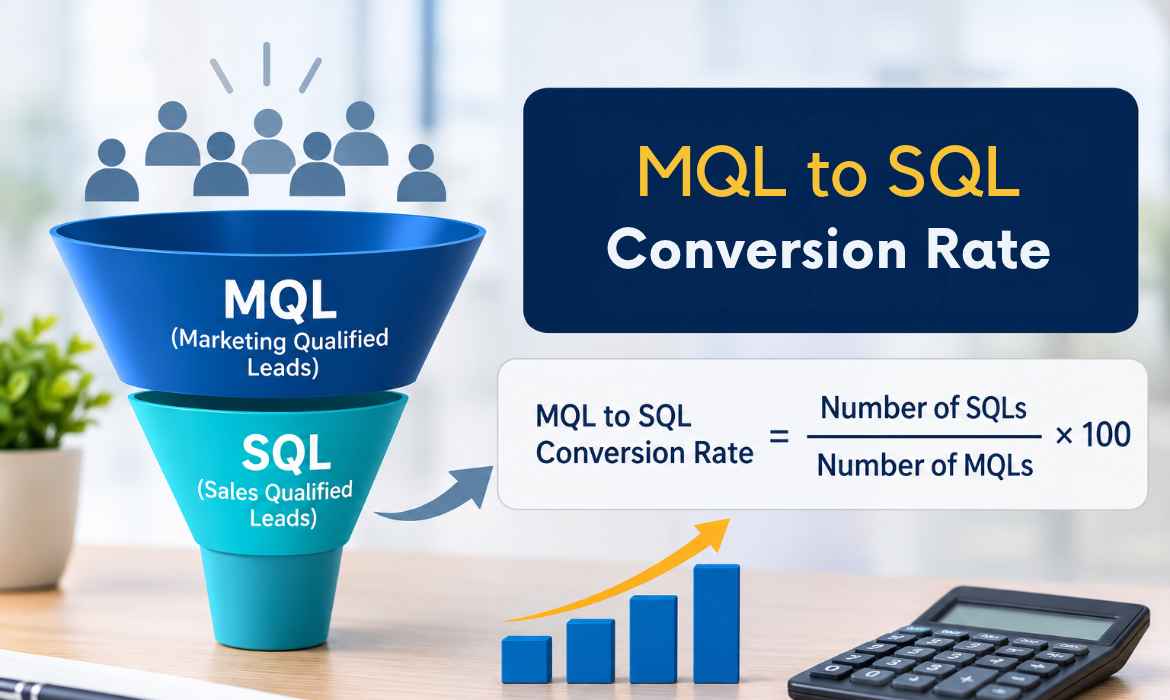
Understanding how leads move from marketing to sales is essential for measuring B2B marketing performance. The MQL to SQL conversion rate helps businesses understand how effectively marketing-qualified leads become sales-qualified leads. It shows whether marketing is attracting prospects who meet the sales team’s expectations and are more likely to enter the sales pipeline.
Instead of measuring success only through the number of leads generated, businesses can use this metric to evaluate lead quality and the effectiveness of their qualification process. A clear calculation also helps marketing and sales teams identify gaps and improve their approach to lead management.
What Is MQL to SQL Conversion Rate?
MQL to SQL conversion rate is the percentage of marketing-qualified leads (MQLs) that become sales-qualified leads (SQLs) during a specific period. It measures how successfully marketing-generated leads progress to the next stage of the sales funnel.
An MQL is a prospect who has shown interest in a company’s products or services and meets predefined marketing qualification criteria. An SQL is a lead that has been reviewed and considered suitable for direct sales engagement based on factors such as business requirements, purchase intent, budget, or decision-making authority.
For B2B companies, this transition is important because not every lead generated through a marketing campaign is ready for a sales conversation. Tracking the MQL to SQL conversion rate helps businesses understand whether their marketing efforts are attracting the right audience.
How to Calculate MQL to SQL Conversion Rate
Calculating the MQL to SQL conversion rate is straightforward. You only need two numbers: the total number of MQLs generated and the number of those MQLs that successfully became SQLs during the same measurement period.
MQL to SQL Conversion Rate Formula:
MQL to SQL Conversion Rate = (Number of SQLs ÷ Number of MQLs) × 100
For example, suppose a B2B company generates 500 marketing-qualified leads in one month. After reviewing these leads, the sales team identifies 125 as sales-qualified leads.
Using the formula:
MQL to SQL Conversion Rate = (125 ÷ 500) × 100
MQL to SQL Conversion Rate = 25%
This means that 25% of the marketing-qualified leads successfully progressed to the sales-qualified stage. The remaining 75% did not become SQLs during the measurement period.
This calculation gives marketing and sales teams a simple way to evaluate how effectively leads move between these two stages.
Practical Example of MQL to SQL Conversion Rate
Let’s consider a B2B company running multiple marketing campaigns to generate leads from business decision-makers. The marketing team tracks MQLs, while the sales team evaluates and qualifies them based on business requirements and purchase readiness.
The company records the following numbers over three months:
| Month | MQLs Generated | SQLs Qualified | Conversion Rate |
| January | 400 | 80 | 20% |
| February | 500 | 125 | 25% |
| March | 600 | 180 | 30% |
The table shows that the company’s MQL to SQL conversion rate increased from 20% in January to 30% in March.
This improvement suggests that a larger proportion of marketing-qualified leads are meeting the sales team’s qualification criteria. It could reflect better audience targeting, improved lead qualification, or stronger alignment between marketing and sales.
However, businesses should also review the quality and consistency of their qualification process before assuming that a higher conversion rate always represents better performance.
Why Is MQL to SQL Conversion Rate Important for B2B Businesses?
The MQL to SQL conversion rate provides useful information about the connection between marketing activities and sales outcomes. It helps businesses understand whether their lead generation efforts are producing prospects who are relevant to their sales objectives.
For marketing teams, this metric highlights how well campaigns attract potential buyers who match the company’s ideal customer profile. If a large number of MQLs fail to qualify for sales, the team may need to review its targeting, campaign messaging, or lead qualification criteria.
For sales teams, the metric provides visibility into the quality of incoming leads. It also helps identify whether the qualification criteria used by marketing match the expectations of sales representatives.
When both teams regularly review this metric, they can identify gaps in the lead handoff process, improve communication, and create a more consistent approach to lead management.
Factors That Affect MQL to SQL Conversion Rate
Several factors can influence how many marketing-qualified leads progress to the sales-qualified stage. Understanding these factors helps businesses identify areas that may require improvement.
Lead Quality: Leads that match the company’s ideal customer profile are more likely to meet sales qualification requirements. Poor audience targeting can increase MQL volume without improving SQL generation.
Lead Qualification Criteria: Different qualification standards between marketing and sales can create gaps. Both teams should agree on the characteristics that define a qualified lead.
Lead Source and Campaign Performance: Leads generated through different channels may show different levels of purchase intent. Reviewing conversion rates by campaign and source can help businesses understand which activities attract more sales-ready prospects.
Follow-Up Timing: Delayed sales follow-ups can reduce the chances of engaging interested prospects. A timely handoff helps sales teams connect with leads while their interest is still active.
How to Improve MQL to SQL Conversion Rate
Improving the MQL to SQL conversion rate requires attention to both lead quality and the qualification process. Generating more MQLs alone may not improve results if those leads do not match the company’s target audience.
Businesses can start by reviewing their ideal customer profile and ensuring that marketing campaigns reach relevant industries, company sizes, and decision-makers. Lead scoring can also help prioritize prospects based on their engagement, business fit, and buying signals.
Another important step is establishing clear MQL and SQL definitions. Marketing and sales teams should regularly review rejected leads, discuss qualification gaps, and adjust their criteria when necessary.
Additionally, tracking conversion rates by lead source and campaign can reveal which marketing activities contribute to better sales-qualified leads. This makes it easier to allocate resources toward channels that deliver stronger lead quality.
Why Tracking MQL to SQL Conversion Matters
The MQL to SQL conversion rate is an important metric for understanding how effectively marketing-qualified leads progress into the sales pipeline. By using a simple formula and reviewing conversion trends regularly, B2B businesses can measure lead quality, identify qualification gaps, and improve marketing and sales alignment.
Rather than focusing only on lead volume, businesses should pay attention to how many generated leads actually meet sales requirements. A consistent measurement process helps both teams make informed decisions and build a more effective lead generation strategy.
Improve Your B2B Lead Generation with Acceligize
Generating relevant leads is an important part of building a strong sales pipeline. Acceligize helps B2B businesses strengthen their lead generation efforts through targeted audience engagement and demand generation solutions. Visit Acceligize to explore how you can connect with the right business audiences and support your sales growth.
What is a good MQL to SQL conversion rate for B2B companies?
A good MQL to SQL conversion rate varies depending on the industry, target audience, and lead generation strategy. Rather than following a fixed benchmark, businesses should compare their conversion rates with historical performance and campaign results to identify improvements.
What is the difference between MQL to SQL conversion rate and lead conversion rate?
MQL to SQL conversion rate measures how many marketing-qualified leads become sales-qualified leads. Lead conversion rate can measure the percentage of leads progressing toward other outcomes, such as opportunities or customers, depending on the stage being tracked.
How often should businesses measure MQL to SQL conversion rate?
B2B businesses should monitor this metric monthly to identify changes in lead quality and qualification performance. Reviewing it quarterly can also help teams understand longer-term trends and evaluate the impact of marketing campaigns.
What causes a low MQL to SQL conversion rate?
A low MQL to SQL conversion rate can result from poor audience targeting, unclear qualification criteria, low purchase intent, or delayed sales follow-ups. Differences between marketing and sales expectations can also prevent qualified leads from progressing through the funnel.