

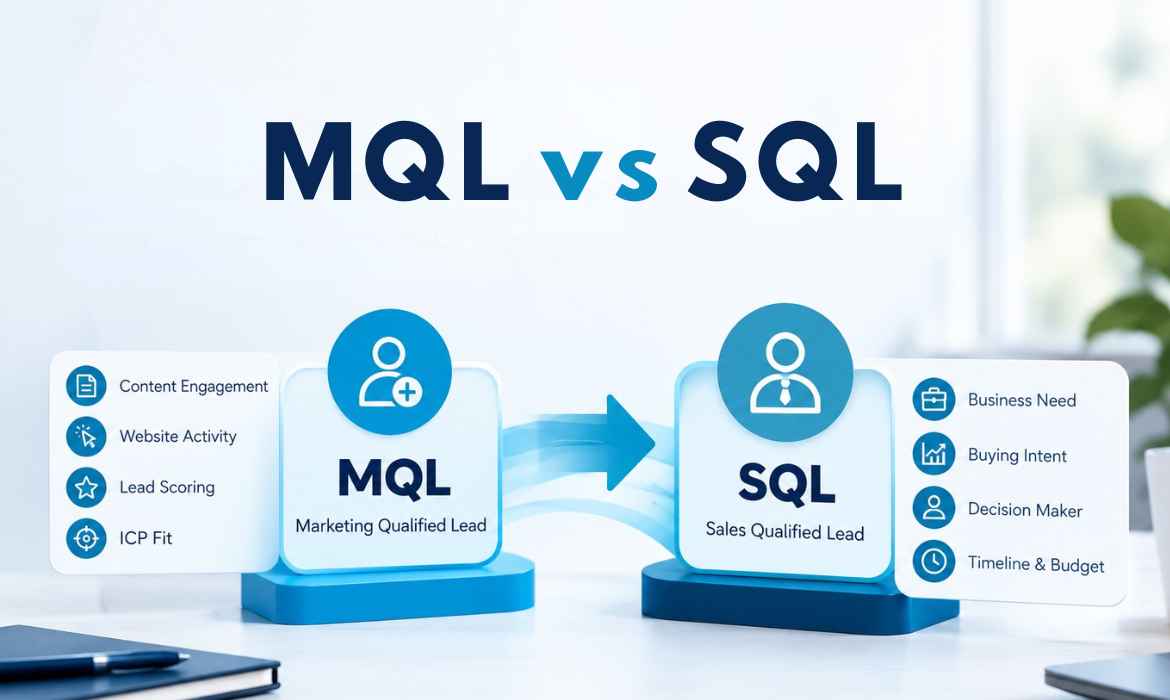
In B2B marketing, generating leads is only the first step toward building a successful sales pipeline. Businesses also need to understand which prospects are interested in their solutions and which are ready to speak with a sales representative. This is where understanding MQL vs SQL becomes important. Marketing qualified leads (MQLs) show meaningful interest in a company’s content or offerings, while sales qualified leads (SQLs) have demonstrated stronger buying intent and meet the criteria for direct sales engagement. Although both types of leads contribute to revenue growth, they represent different stages of the buyer journey. Understanding these differences helps marketing and sales teams prioritize prospects, improve lead handoffs, and focus their efforts on opportunities with greater conversion potential.
What Is a Marketing Qualified Lead (MQL)?
A marketing qualified lead is a prospect who has shown enough interest in a company’s products, services, or content to receive further marketing attention. This interest may appear through website visits, content downloads, webinar registrations, email engagement, or repeated interactions with relevant resources. However, a single interaction does not automatically make someone an MQL. Marketing teams typically evaluate several engagement signals alongside the prospect’s company profile, job role, and potential fit with the ideal customer profile (ICP).
For example, consider a marketing manager at a mid-sized technology company who downloads a B2B lead generation guide, attends a webinar, and visits several service pages. These activities suggest that the person is researching solutions related to their professional responsibilities. If the company also fits the target audience and the prospect reaches the organization’s lead scoring threshold, the marketing team may classify them as an MQL.
MQLs are valuable because they help marketing teams identify prospects who deserve more focused attention. At this stage, the lead may still be exploring options, learning about a business problem, or comparing approaches. Therefore, the goal is often to provide relevant information, build trust, and identify stronger buying signals rather than immediately push for a sales conversation.
What Is a Sales Qualified Lead (SQL)?
A sales qualified lead (SQL) is a prospect who is ready to engage with the sales team. Unlike an MQL, an SQL shows stronger buying intent. The prospect may have a clear business need or may be ready to evaluate a solution. Sales representatives can assess this through discovery calls and qualification questions. A consultation request or other meaningful interaction can also indicate a genuine business opportunity.
For instance, the marketing manager from the earlier example requests a meeting to discuss lead generation services. During the conversation, the representative learns that the company needs to improve lead quality, has an established budget, and plans to implement a solution within the next quarter. If these details align with the organization’s qualification criteria, the prospect may be accepted as an SQL.
An SQL does not necessarily mean that the prospect will become a customer. The company may still need to evaluate vendors, secure internal approval, compare pricing, and complete procurement. Nevertheless, the prospect has progressed beyond general interest and is ready for a more direct sales discussion. This distinction helps sales teams concentrate on qualified opportunities instead of spending equal time on every incoming lead.
MQL vs SQL: Key Differences
The primary difference between an MQL and an SQL is the level of demonstrated sales readiness. An MQL has shown relevant interest and potential fit, whereas an SQL has passed additional qualification checks and is ready for sales engagement. Both are important, but they serve different purposes in the B2B revenue process.
| Comparison factor | MQL | SQL |
| Qualification stage | Marketing evaluation | Sales evaluation |
| Primary indicator | Engagement and potential fit | Confirmed need and stronger buying intent |
| Responsible team | Marketing | Sales |
| Typical signals | Content downloads, webinar attendance, repeat visits | Consultation requests, discovery conversations, confirmed business needs |
| Main objective | Nurture interest and assess readiness | Evaluate the opportunity and determine next steps |
| Typical next action | Targeted content, email nurturing, additional qualification | Sales outreach, discovery, solution discussion |
| Purchase readiness | May still be researching | Ready for a sales conversation |
| Success measurement | MQL quality and progression | SQL acceptance, opportunity creation, and conversion |
These distinctions are guidelines rather than universal rules. Every B2B organization should define qualification criteria based on its sales cycle, product complexity, average contract value, and target audience. For example, a software company selling to enterprise buyers may require several qualification steps, while a business offering a straightforward service may move suitable prospects to sales more quickly.
Suggested in-content infographic placement: Add a comparison visual immediately after this section. Show MQL on the marketing side and SQL on the sales side, with engagement signals, buying intent, and the transition between stages. This gives readers a quick visual summary without repeating the entire article.
MQL vs SQL Qualification Criteria
Clear qualification criteria help marketing and sales teams determine when a prospect should move from one stage to another. Without shared definitions, marketing may send unqualified leads to sales. Sales may also miss promising prospects who have shown genuine interest.
Marketing Qualified Lead Criteria
MQL qualification generally combines lead fit with engagement. Marketing teams assess whether the prospect belongs to the intended audience and whether their behavior indicates relevant interest. Common considerations include company size, industry, job function, seniority, content consumption, website activity, and responses to marketing campaigns.
Lead scoring can make this process more consistent. For example, a company may assign points for visiting a service page, attending a product webinar, or downloading a relevant industry report. Additional points may reflect a strong ICP match, such as working in a target industry or holding a relevant decision-making role. Once a prospect reaches a predefined threshold, the marketing team can review the lead for MQL status.
However, engagement alone should not determine qualification. A student researching a topic may download several reports without having any purchasing responsibility. Combining behavioral signals with demographic and firmographic information helps marketing teams distinguish genuine business prospects from less relevant contacts.
Sales Qualified Lead Criteria
SQL qualification focuses on whether the prospect has a credible business need and is ready for a sales conversation. Depending on the organization, representatives may assess budget availability, decision-making authority, the problem being addressed, implementation timelines, and the prospect’s willingness to evaluate potential solutions.
Frameworks such as BANT, which stands for Budget, Authority, Need, and Timeline, can help structure discovery conversations. Nevertheless, teams should apply these criteria flexibly. Some enterprise buyers may have a confirmed business problem before the budget is finalized, while purchasing decisions may involve several stakeholders rather than one individual.
A strong qualification process also checks whether the proposed solution fits the prospect’s requirements. This reduces the likelihood of sending unsuitable leads into the sales pipeline and allows representatives to spend more time on realistic opportunities.
Practical B2B Examples of MQLs and SQLs
Consider a company that provides B2B demand generation services. A marketing director from a target industry visits the website, reads two articles about lead qualification, and downloads a guide on improving campaign performance. The director matches the company’s target customer profile but has not requested a conversation or shared a specific project requirement. Based on the organization’s lead scoring rules, this person could qualify as an MQL.
Now suppose the same director returns to the website, submits a consultation form, and explains that the company needs to improve its pipeline of qualified leads. A sales representative follows up and confirms the target audience, business challenge, expected implementation period, and suitability of the service. If these details meet the agreed criteria, the lead can progress to SQL status.
A different example highlights why engagement should not be the only factor. An employee might download five resources and attend several webinars but work for a company outside the service provider’s target market. Despite substantial engagement, this contact may not qualify as an MQL because the business fit is weak. Conversely, a suitable decision-maker who requests a consultation may be ready for prompt sales review even without extensive prior engagement.
These scenarios show why effective qualification requires context. The number of interactions matters, but the relevance of those interactions, the prospect’s business profile, and their readiness to evaluate a solution are equally important.
How to Move Leads from MQL to SQL
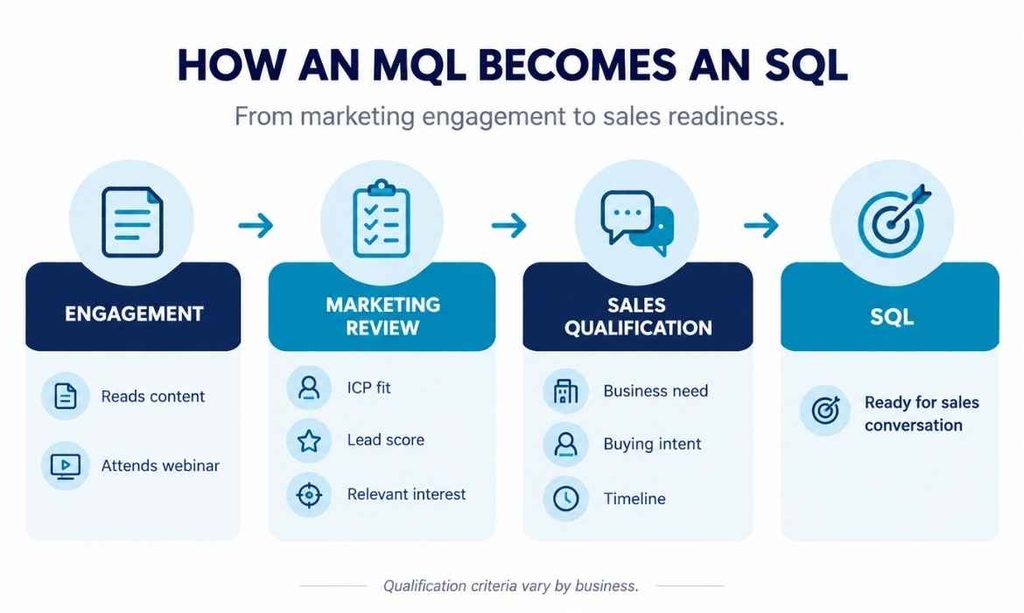
Moving prospects from marketing qualification to sales qualification requires a coordinated process rather than a simple transfer of contact information. Marketing teams should continue providing relevant content while monitoring signals that indicate a stronger need for the solution. For example, repeated visits to pricing or service pages, requests for detailed information, and participation in product-focused events may justify a closer review.
Marketing and sales should also agree on a clear handoff process. This includes defining the MQL threshold, specifying the information that accompanies each lead, setting response expectations, and establishing how sales representatives should accept or reject transferred leads. When a lead is not ready, sales should provide a clear reason so marketing can adjust its nurturing approach.
Lead nurturing is particularly important for prospects who show interest but need more time to make a decision. Educational emails, case studies, relevant industry insights, and practical resources can help prospects understand their options. At the same time, marketing automation and CRM systems can track engagement, maintain contact records, and alert teams when new qualification signals appear.
The objective is not to move every lead into sales as quickly as possible. Instead, organizations should help suitable prospects progress at the right pace while preserving a consistent experience throughout the buying journey.
Common Reasons MQLs Fail to Convert into SQLs
A gap between MQLs and SQLs can indicate problems with lead quality, qualification rules, or coordination between teams. One common issue is an overly broad scoring model that rewards activity without considering whether the prospect fits the target market. Another is a qualification threshold that does not reflect actual buying behavior, resulting in leads being transferred before they are ready.
Poor timing can also affect conversion. A prospect may have a genuine business need but lack the budget, internal approval, or implementation capacity to move forward immediately. In such cases, continued nurturing may be more appropriate than repeated sales outreach.
Finally, inconsistent feedback can make it difficult to identify the underlying problem. Marketing needs to know why sales rejects leads, while sales needs accurate information about the prospect’s interests and previous interactions. Regular reviews of rejected leads, conversion patterns, and sales feedback help both teams refine their criteria and improve lead quality over time.
How to Measure MQL-to-SQL Conversion
Tracking the progression from MQL to SQL helps businesses understand whether their lead generation and qualification processes are producing sales-ready prospects. One useful metric is the MQL-to-SQL conversion rate, which measures the percentage of MQLs that become SQLs during a defined period or cohort.
MQL-to-SQL conversion rate = (Number of MQLs that become SQLs ÷ Total MQLs) × 100
For example, if 200 leads are classified as MQLs and 60 later become SQLs, the conversion rate is 30%. This figure provides a starting point for evaluating lead quality, but it should be interpreted alongside the company’s sales cycle and qualification standards.
Teams should also monitor SQL acceptance rates, opportunity creation, cost per qualified lead, and eventual customer conversion. Reviewing these metrics by channel, campaign, industry, and audience segment can reveal which sources deliver the most relevant prospects. The goal is to improve the quality and commercial value of leads, not simply increase the total number generated.
Improve B2B Lead Qualification with Acceligize
Understanding the difference between marketing-qualified and sales-qualified leads is an important step toward building a more effective B2B revenue pipeline. When businesses define clear qualification criteria, monitor meaningful buying signals, and align marketing with sales, they can reduce wasted effort and focus on prospects with stronger potential. Acceligize helps B2B organizations strengthen their lead generation efforts through audience-focused approaches designed to connect businesses with relevant prospects. Explore Acceligize to learn more about B2B lead generation and discover how a more focused approach to identifying and engaging potential buyers can support your demand generation goals.
What is the difference between an MQL and an SQL in B2B marketing?
An MQL is a lead who has shown interest in a company’s content, products, or services and meets marketing qualification criteria. An SQL has been reviewed and qualified by the sales team as a potential buyer with a relevant business need and sales readiness. The main difference is the lead’s readiness for direct sales engagement.
How do you determine when an MQL becomes an SQL?
An MQL becomes an SQL when further evaluation confirms that the lead fits the ideal customer profile and shows genuine buying potential. Sales teams typically assess business needs, decision-making authority, purchase intent, budget, and timeline where relevant. Clear marketing and sales qualification criteria help make this transition more consistent.
What is a good MQL-to-SQL conversion rate for B2B companies?
There is no universal benchmark for a good MQL-to-SQL conversion rate because results vary by industry, target audience, lead source, and sales cycle. B2B companies should track the percentage of MQLs accepted as SQLs over time and compare performance across campaigns. This helps identify which lead generation activities produce sales-ready prospects.
How can B2B companies improve MQL-to-SQL conversion rates?
B2B companies can improve MQL-to-SQL conversion by defining shared qualification criteria, improving lead scoring, and targeting prospects that match their ideal customer profile. Timely follow-ups, accurate contact data, and regular feedback between marketing and sales also help reduce unqualified handoffs. Reviewing conversion data by campaign and lead source can reveal where improvements are needed.