
Generating leads is only the beginning of a successful B2B sales process. Sales teams must also identify which prospects have a genuine business need, the ability to purchase, and a realistic plan to move forward. Without a consistent qualification process, representatives can spend valuable time on leads that show interest but have little chance of becoming customers. The BANT framework helps sales teams evaluate these factors through a structured set of questions.
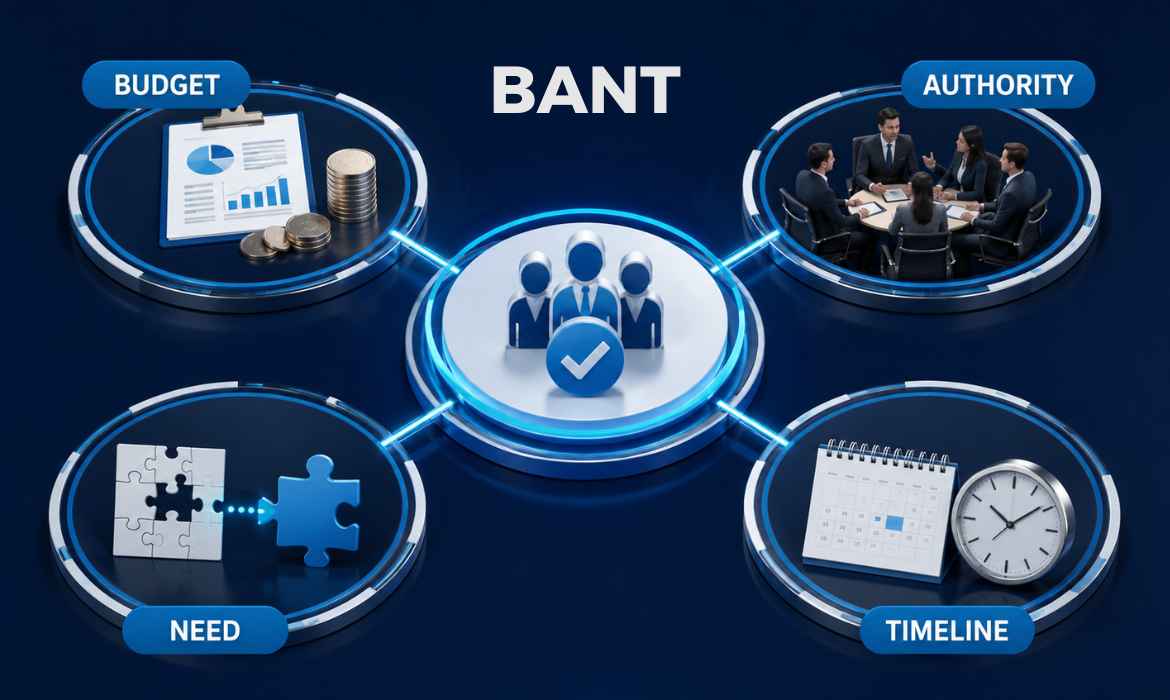
BANT stands for Budget, Authority, Need, and Timeline. These four criteria help sales representatives understand a prospect’s purchasing readiness before investing significant time in an opportunity. Rather than relying on assumptions or a prospect’s initial interest, teams can use BANT to gather information and make informed decisions about the next steps.
For B2B organizations, effective lead qualification also improves coordination between marketing and sales. Marketing teams can identify potential buyers through their engagement and company profiles, while sales representatives can investigate their specific requirements. By applying the BANT framework during discovery calls and follow-up conversations, both teams can focus on opportunities that align with business objectives and sales priorities.
What Is the BANT Framework?
The BANT framework is a sales qualification methodology that helps representatives assess whether a potential customer is worth pursuing. It examines four important aspects of a purchasing decision: available budget, decision-making authority, business need, and expected purchase timeline.
Each component provides a different perspective on the prospect’s readiness to buy. Budget helps determine financial feasibility, while authority identifies the people involved in approving a purchase. Need reveals the business problem that requires attention, and timeline establishes when the organization expects to make a decision.
The framework provides a common structure for evaluating leads across sales teams. Representatives can use the same criteria to record prospect information, compare opportunities, and determine which leads deserve immediate attention. However, BANT should support meaningful conversations rather than become a rigid checklist that every prospect must complete during the first call.
For example, a company may express interest in improving its lead generation process but have no approved budget yet. Another prospect may have funding available but lack a clear business reason to change its current approach. The BANT framework helps sales representatives identify these differences and decide how to proceed.
Why the BANT Framework Matters for B2B Lead Qualification
B2B purchases often involve multiple stakeholders, internal approvals, financial considerations, and longer evaluation periods. A prospect’s interest alone does not establish whether the opportunity is commercially viable. Sales teams need a clearer understanding of the circumstances behind each inquiry.
The BANT framework provides a repeatable way to gather this information. It helps representatives distinguish between prospects who are actively evaluating a solution and those who are still researching their options. Consequently, sales teams can prioritize their efforts according to opportunity quality rather than lead volume alone.
It also supports more accurate sales forecasting. When representatives document a prospect’s requirements, purchasing process, and expected timing, managers gain better visibility into potential deals. Marketing teams can use this feedback to review lead quality and refine their targeting or qualification criteria.
Most importantly, BANT encourages representatives to understand the buyer’s situation before presenting a solution. This creates more relevant sales conversations and helps teams connect their offerings with the business outcomes prospects want to achieve.
The Four Components of the BANT Framework and Questions to Ask
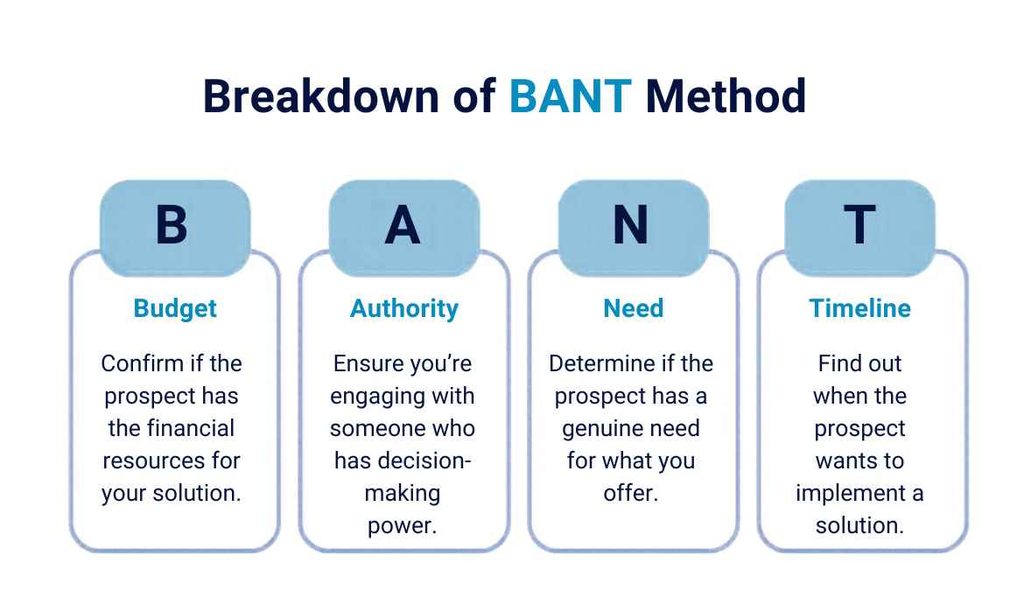
The BANT framework evaluates four important aspects of a purchasing decision: available budget, decision-making authority, business need, and expected purchase timeline.
1. Budget: Does the Prospect Have the Financial Resources?
Budget qualification helps sales representatives understand whether a prospect can fund a potential purchase. However, the absence of an approved budget does not automatically mean the lead is unqualified. Some organizations need to build a business case before allocating funds, while others may be waiting for the next planning cycle.
The objective is to understand how the prospect expects to fund the project, what financial limitations exist, and whether the expected investment is realistic. Representatives should explore these points tactfully instead of immediately asking for an exact budget figure.
Questions to ask about budget:
- Has your organization allocated a budget for this initiative?
- How are projects like this typically funded within your company?
- Are you evaluating solutions within a particular investment range?
- Would additional budget approval be required before moving forward?
- What business results would justify the investment?
The answers help representatives assess financial readiness and identify potential obstacles. For instance, a prospect with an approved budget and a clear investment range may be ready for a detailed proposal. A company that needs executive approval may require additional information about expected returns, implementation costs, and business benefits.
2. Authority: Who Is Involved in the Buying Decision?
Authority qualification identifies the people who influence, evaluate, approve, or sign off on a purchasing decision. In B2B sales, the person who first contacts a company may not control the budget or have final approval. Several stakeholders may participate, depending on the purchase value and organizational structure.
Sales representatives should therefore understand the prospect’s role and internal decision-making process. Building a relationship with the initial contact remains important, but identifying other stakeholders early can prevent delays later in the sales cycle.
Questions to ask about authority:
- Who else will participate in evaluating this solution?
- Which teams will be affected by the purchasing decision?
- Who typically approves investments of this size?
- What steps does your organization follow when selecting a vendor?
- Would it be helpful to include other stakeholders in our next discussion?
These questions reveal how purchasing decisions happen within the organization. A marketing manager, for example, may recognize the need for better lead data but require approval from sales leadership, finance, and procurement.
Understanding these relationships helps representatives prepare relevant information for each stakeholder. It also reduces the risk of progressing an opportunity without knowing who must approve the final decision.
3. Need: What Business Problem Must Be Solved?
Need is often one of the most important components of the BANT framework because it connects a prospect’s interest with a genuine business challenge. A lead may download a resource, attend a webinar, or request information without having an immediate requirement. Sales representatives must determine whether the prospect faces a problem that the offered solution can realistically address.
Effective need qualification explores the current situation, the impact of the problem, and the consequences of leaving it unresolved. Representatives should also understand what the organization has already tried and why existing approaches may not be sufficient.
Questions to ask about need:
- What is the biggest challenge your team is trying to address?
- How does this challenge affect your current business results?
- What solutions or approaches have you already tried?
- Which outcomes would you like to improve?
- What could happen if this problem remains unresolved?
The answers help representatives understand the problem beyond its surface description. For example, a company seeking better lead generation may actually be struggling with low conversion rates, incomplete prospect data, or poor alignment between marketing and sales.
Each challenge may require a different solution. By identifying the underlying requirement, representatives can explain relevant benefits and determine whether their offering matches the prospect’s priorities.
4. Timeline: When Does the Prospect Plan to Act?
Timeline qualification helps representatives understand when a prospect expects to make a purchasing decision and what might influence that schedule. Some organizations have urgent requirements linked to a product launch, contract renewal, or revenue target. Others may be exploring options for a future planning cycle.
Knowing the expected timeline allows sales teams to organize follow-ups and prioritize opportunities more effectively. It also helps representatives distinguish between a prospect who is ready to evaluate vendors and one who needs additional education before making a decision.
Questions to ask about timeline:
- When would you ideally like to implement a solution?
- Is there a particular business event driving this decision?
- When do you expect to finalize your vendor evaluation?
- Are there internal approvals that could affect the schedule?
- What needs to happen before your organization can move forward?
A clear timeline gives the sales team a practical basis for planning the next interaction. For example, a company aiming to improve lead qualification before the next quarter may need a faster evaluation process than an organization considering changes later in the year.
However, an uncertain timeline should not automatically disqualify a lead. Representatives should investigate whether the prospect needs more information, additional approvals, or a stronger business case before committing to a purchase.
How to Apply the BANT Framework During Lead Qualification
Using BANT effectively requires more than asking four sets of questions. Sales teams must connect the answers, document the findings, and use the information to decide on appropriate next steps.
Start with the prospect’s business context. Before a discovery call, review the company’s industry, business model, role of the contact, and interactions with your organization. This background helps representatives ask relevant questions instead of relying on a generic script.
Make the conversation natural. The order of BANT questions can change according to the situation. A prospect who requests a proposal may be ready to discuss budget and approval requirements. Someone who is still exploring a problem may need to discuss business challenges first.
Record the answers in your CRM. Document confirmed information about the prospect’s requirements, budget status, stakeholders, and purchase timeline. Distinguish between facts shared by the prospect and assumptions made by the representative. This gives other team members a reliable view of the opportunity.
Agree on the next step. Use the conversation to establish what should happen next. Depending on the prospect’s readiness, this might involve a product demonstration, a meeting with another stakeholder, a business case, or a future follow-up.
A consistent process makes qualification more useful across the sales pipeline. It also allows managers to identify recurring barriers, such as missing budget approvals or limited access to decision-makers.
BANT Framework Example: Qualifying a B2B Lead
Consider a B2B company that wants to improve its lead generation and qualification process. A marketing manager contacts a service provider after reading an article about improving lead quality. The initial inquiry shows interest, but the sales representative needs more information before deciding whether to advance the opportunity.
During the discovery conversation, the representative learns that the company has difficulty identifying qualified prospects and wants to improve conversion rates. The marketing manager explains that the team is evaluating external support and has a preliminary investment range. However, the final budget requires approval from the head of marketing and finance.
The representative also discovers that the company wants to improve its process before the next quarter. This creates a clear reason to explore the opportunity, although the approval process still needs clarification.
Using the BANT framework, the representative can document the findings as follows:
| BANT criterion | Qualification finding |
| Budget | Preliminary investment range identified; final approval pending |
| Authority | Marketing manager is the initial contact; additional approvers identified |
| Need | Lead quality and conversion challenges confirmed |
| Timeline | Target is to improve the process before the next quarter |
This lead appears promising because the business problem is clear and there is a defined target date. However, the opportunity is not fully qualified until the team understands the approval process and confirms financial feasibility.
The representative can now arrange a follow-up meeting with the relevant stakeholders and prepare information that supports the business case. This approach moves the conversation forward without assuming that initial interest guarantees a purchase.
Common Mistakes to Avoid When Using the BANT Framework
One common mistake is treating every BANT criterion as a strict pass-or-fail requirement. A prospect without an approved budget may still represent a valuable opportunity if the business need is significant and funding can be secured. Sales representatives should evaluate the complete situation rather than reject leads based on one unanswered question.
Another mistake is focusing on the initial contact instead of the wider buying group. Complex B2B purchases often involve several decision-makers, technical evaluators, and financial approvers. Failing to identify these stakeholders can create unexpected delays during the final stages of the sales process.
Representatives may also ask qualification questions too early or too aggressively. Direct questions about money and authority can make prospects uncomfortable when the business problem has not yet been established. A better approach is to build context, explain why the information matters, and allow the discussion to develop naturally.
Finally, teams should avoid relying on incomplete CRM records or outdated qualification information. A prospect’s priorities, budget, and timing can change. Regular follow-ups and accurate documentation help representatives maintain a realistic understanding of each opportunity.
How BANT Supports Marketing and Sales Alignment
The BANT framework can strengthen the relationship between marketing and sales when both teams agree on what qualifies a lead for further engagement. Marketing teams can use company information, campaign interactions, and declared interests to identify potential opportunities. Sales representatives can then validate the prospect’s needs, purchasing process, and readiness through direct conversations.
This shared approach helps reduce disagreements over lead quality. Instead of relying only on the number of leads generated or meetings booked, both teams can evaluate whether prospects match the ideal customer profile and demonstrate a credible business requirement.
BANT findings can also inform future marketing campaigns. If sales representatives repeatedly encounter leads without a clear need or realistic purchase timeline, marketing can review audience targeting, content messaging, and lead nurturing activities. Similarly, recurring budget or approval barriers may indicate a need for better educational content that helps buyers build internal business cases.
When these insights are shared consistently, BANT becomes more than a sales checklist. It supports a feedback loop that improves qualification, prioritization, and the overall efficiency of B2B lead generation.
When Should B2B Sales Teams Use BANT?
The BANT framework is particularly useful when sales representatives need a straightforward method to evaluate opportunities during discovery calls. It can work well for products and services with identifiable purchasing requirements, established sales processes, and prospects who are already considering a solution.
However, complex enterprise purchases may require additional qualification methods. Large buying committees, lengthy procurement processes, and requirements that evolve during evaluation can make the four BANT criteria insufficient on their own. In these situations, teams may combine BANT with approaches that examine decision criteria, business impact, stakeholder relationships, and the customer’s broader purchasing process.
The key is to adapt qualification to the sales environment. BANT should help representatives understand the opportunity and choose the right next step, not force every prospect into the same buying pattern.
For B2B organizations, the strongest qualification process combines a clear framework with active listening, accurate prospect data, and regular communication between marketing and sales. This makes it easier to recognize promising opportunities while maintaining productive relationships with buyers who need more time.
Improve Your B2B Lead Qualification Process
Effective lead qualification helps B2B organizations direct their sales efforts toward prospects with relevant needs, realistic purchasing plans, and a clear path to a decision. The BANT framework provides a practical starting point by organizing discovery conversations around budget, authority, need, and timeline. When teams use these criteria thoughtfully, they can identify gaps earlier, improve follow-up decisions, and create a more consistent sales process.
Acceligize helps B2B organizations strengthen their lead generation efforts and connect with relevant business audiences. Explore Acceligize to learn how targeted B2B lead generation and demand generation strategies can support your pipeline development and help your sales team focus on more relevant opportunities.
What is the BANT framework in B2B sales?
The BANT framework is a lead qualification method that evaluates Budget, Authority, Need, and Timeline. It helps B2B sales teams understand a prospect’s purchasing readiness, identify potential barriers, and prioritize opportunities with a stronger chance of conversion.
How do you qualify a lead using the BANT framework?
To qualify a lead using the BANT framework, ask questions about the prospect’s available budget, decision-making process, business challenges, and expected purchase timeline. Record the answers in your CRM and use them to determine the next steps, such as a product demonstration, follow-up meeting, or further nurturing.
Is the BANT framework suitable for complex B2B sales cycles?
Yes, the BANT framework can support complex B2B sales cycles by helping representatives assess financial readiness, stakeholder involvement, business needs, and purchasing timelines. However, enterprise deals may require additional qualification methods to understand multiple decision-makers, procurement requirements, and evolving business priorities.
What are the limitations of the BANT framework in lead qualification?
The BANT framework may not fully capture opportunities where budgets are unapproved, purchasing timelines are uncertain, or several stakeholders influence the decision. Strictly applying all four criteria can lead sales teams to overlook promising prospects. Combining BANT with ongoing lead nurturing and regular qualification reviews provides a more flexible approach.