
B2B email marketing remains an important channel for reaching business decision-makers, nurturing potential customers, and building lasting professional relationships. However, sending regular emails does not guarantee engagement. Business inboxes receive numerous promotional messages, making it harder for marketers to capture attention and encourage meaningful action. To achieve better results, businesses need to focus on relevant content, accurate audience targeting, and well-planned communication.
Unlike consumer marketing, B2B campaigns often involve longer buying cycles and multiple stakeholders. A marketing manager may look for ways to improve campaign performance, while a sales leader may prioritize qualified leads and revenue growth. Therefore, successful B2B email marketing requires a clear understanding of the audience, its challenges, and its position in the buying journey.
The right approach can help marketing teams improve email engagement, strengthen lead nurturing, and support sales pipeline growth. By applying proven practices and monitoring meaningful performance indicators, businesses can turn email campaigns into a more effective part of their overall lead generation strategy.
Why B2B Email Marketing Matters for Business Growth
B2B email marketing gives businesses a direct way to communicate with prospects throughout the buying journey. It helps marketers share useful resources, introduce relevant solutions, and maintain relationships with potential customers who may not be ready to purchase immediately. Instead of relying on a single interaction, businesses can build familiarity through consistent and valuable communication.
Another advantage is the ability to tailor messages to different audiences. For example, a company targeting IT decision-makers can share cybersecurity insights, technology guides, and practical case studies. Meanwhile, its finance-focused campaigns can highlight cost efficiency, risk management, and business performance. This relevance makes communication more useful and gives recipients a stronger reason to engage.
Email also supports other B2B marketing activities, including content syndication, account-based marketing, and lead nurturing. When these activities work together, marketers can deliver consistent messages across different touchpoints. The result is a more connected experience that helps prospects understand their challenges and evaluate potential solutions.
1. Segment Your Email Audience Strategically
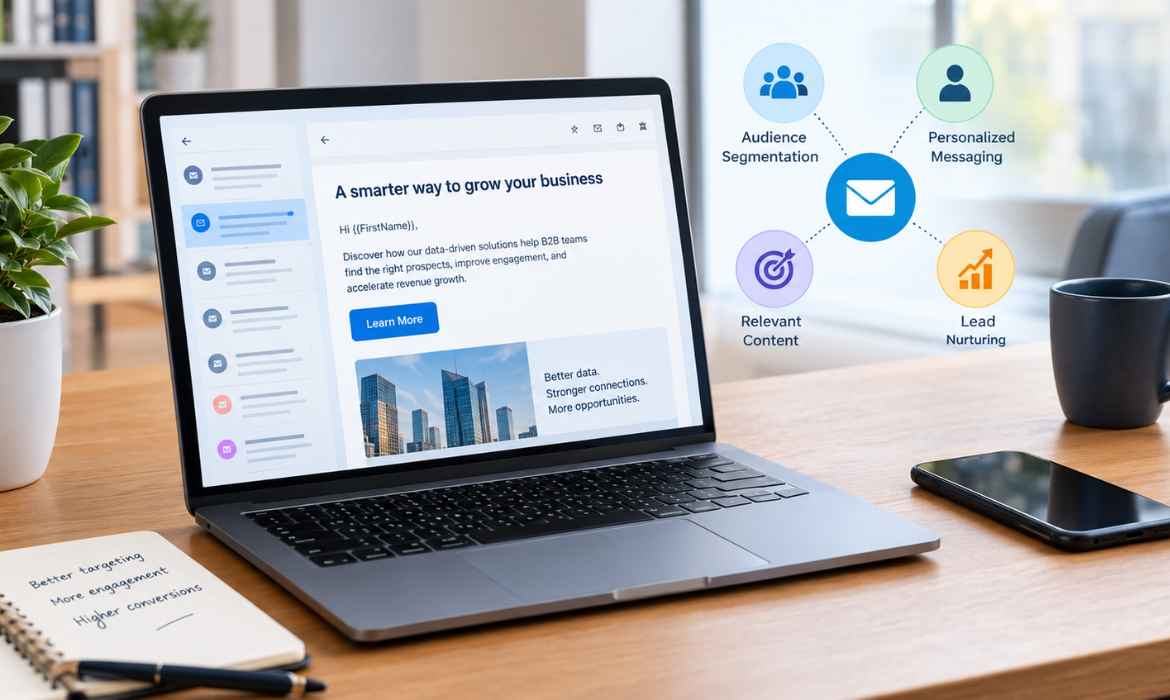
Audience segmentation is one of the most important B2B email marketing best practices because different business contacts have different needs. Sending the same message to an entire database often reduces relevance and limits engagement. Instead, marketers should organize contacts into meaningful groups before planning their campaigns.
Useful segmentation criteria include industry, company size, job title, seniority, geographic location, and buying stage. Engagement history can provide additional context. For instance, someone who recently downloaded a research report may benefit from related educational content, while a prospect who requested a product demonstration may need more detailed information about implementation and business outcomes.
Segmentation should also reflect the challenges each audience faces. A sales director may respond to content about pipeline visibility, whereas a demand generation manager may prefer guidance on campaign attribution and lead quality. By matching content to these priorities, businesses can make their B2B email marketing campaigns more relevant without creating an entirely different email for every contact.
2. Personalize Emails Beyond First Names
Adding a recipient’s name to an email is a simple starting point, but meaningful personalization goes much further. Effective B2B email marketing considers the recipient’s professional responsibilities, company needs, previous interactions, and potential business challenges.
For example, an email to a marketing operations leader could discuss improving lead data accuracy and campaign reporting. A message to a sales development leader might focus on identifying qualified prospects and improving outreach efficiency. Although both recipients may work for the same company, their priorities are different.
Behavioral information can make personalization more useful. If a prospect downloads an industry report, the next email could offer a related case study or practical checklist. Similarly, someone who attends a webinar could receive a follow-up message containing key insights and additional resources.
However, personalization should rely on accurate, appropriately collected information. Incorrect job titles, outdated company details, or irrelevant references can weaken trust. Businesses should regularly review their contact data and use personalization to improve relevance rather than simply make emails appear customized.
3. Write Subject Lines That Communicate Clear Value
The subject line is often the first part of an email a recipient notices. A vague or overly promotional subject may cause business contacts to ignore the message, even when its content is useful. Strong subject lines communicate the topic clearly and give recipients a practical reason to open the email.
For B2B email marketing, specificity is usually more useful than exaggerated promises. A subject such as “Improve Lead Qualification Across Your Sales Funnel” explains the topic more clearly than “An Incredible Opportunity for Your Business.” The first option sets a relevant expectation and attracts readers who care about the subject.
Keep subject lines concise, natural, and closely connected to the email content. Avoid excessive capitalization, misleading urgency, and unnecessary punctuation. These tactics may attract attention temporarily but can damage credibility.
Preheader text also deserves attention because it provides additional context beside or below the subject line, depending on the email client. Use it to explain the benefit of reading the message rather than repeating the subject. Test different approaches with comparable audience segments to identify which messages generate meaningful engagement.
4. Create Valuable Content Instead of Constant Promotions
Business buyers rarely want every email to contain a sales pitch. They need information that helps them understand problems, evaluate options, and make informed decisions. Therefore, an effective B2B email marketing strategy should prioritize educational value alongside promotional communication.
Useful email content can include industry research, practical guides, original insights, customer success stories, webinar invitations, and expert recommendations. For example, a lead generation company could share a guide explaining how better contact data improves campaign targeting. This provides immediate value while helping readers understand the importance of data quality.
The content should also match the recipient’s buying stage. Early-stage prospects may benefit from educational articles that explain a business challenge. Prospects evaluating solutions may prefer comparison guides, implementation resources, or relevant case studies. Those approaching a purchasing decision may need product details, demonstrations, and information about expected outcomes.
Keep each message focused on one central idea. Explain the problem, present useful information, and guide the reader toward an appropriate next step. This approach makes emails easier to understand and helps businesses build credibility through consistent, relevant communication.
5. Use Clear Calls to Action
A call to action (CTA) tells recipients what to do after reading an email. Without a clear next step, even useful content may fail to generate clicks, inquiries, or conversions. Every B2B email marketing campaign should therefore have a specific objective and a CTA that supports it.
The right CTA depends on the purpose of the message. An educational newsletter might encourage readers to explore a related article. A webinar invitation could ask them to register, while a product-focused email might offer a demonstration. These actions should align with the information provided and the recipient’s likely level of interest.
Use straightforward CTA wording that explains the value of taking action. Phrases such as “Read the Complete Guide,” “Explore the Research,” or “Request a Demo” are more informative than generic instructions such as “Click Here.” Place the CTA where readers can find it easily, and make sure the destination page delivers what the email promises.
Avoid including several competing CTAs in a single message. Too many options can distract readers and weaken the campaign’s main objective. A secondary link may be appropriate when it supports the primary action, but the email should maintain a clear direction.
6. Optimize Email Design for Mobile Devices
Many professionals check their emails between meetings, while travelling, or during short breaks. A message that looks attractive on a desktop but becomes difficult to read on a phone can create unnecessary friction. Mobile-friendly design is therefore an important part of B2B email marketing.
Use a responsive email template that adjusts to different screen sizes. Choose readable fonts, maintain sufficient spacing, and keep paragraphs focused. Images should support the message rather than overwhelm it, and essential information should remain understandable even when images are blocked.
The layout should also make the next step easy to identify. Use clear links and appropriately sized CTA buttons that are comfortable to tap on mobile screens. Avoid complicated layouts with multiple columns if they make the message difficult to navigate on smaller devices.
Before launching a campaign, test it across common email clients and screen sizes. Check that links work, images load correctly, and the content remains easy to scan. A straightforward design helps recipients focus on the message instead of struggling with its presentation.
7. Maintain Email Deliverability and List Quality
Even a well-written email cannot generate engagement if it never reaches the intended inbox. Deliverability depends on several factors, including sender reputation, authentication, list quality, and recipient feedback. Businesses must address these fundamentals before increasing campaign volume.
Start by verifying that your sending domain is configured correctly. Sender Policy Framework (SPF), DomainKeys Identified Mail (DKIM), and Domain-based Message Authentication, Reporting and Conformance (DMARC) help receiving systems verify email sources and assess message authenticity. Google and Yahoo have also introduced authentication and other requirements for qualifying bulk senders, making technical compliance an essential part of email operations.
Maintain a clean contact database by removing invalid addresses, managing hard bounces, and reviewing inactive contacts. Use appropriate, permission-based list-building practices and provide a clear way for recipients to unsubscribe. Sending repeated messages to uninterested contacts can increase complaints and damage sender reputation.
Review bounce rates, spam complaints, and engagement trends regularly. If campaign performance declines suddenly, investigate list quality, sending practices, and authentication before simply increasing the number of emails. Reliable delivery provides the foundation for every other B2B email marketing improvement.
8. Automate Lead Nurturing With Relevant Follow-Ups
Marketing automation helps businesses deliver timely communication without manually managing every interaction. It can support welcome emails, content follow-ups, webinar reminders, and lead nurturing sequences. When designed thoughtfully, automation makes B2B email marketing more consistent while allowing teams to respond to changing prospect interests.
For example, a prospect who downloads a guide about lead qualification could receive a follow-up email with related research. A later message might explain common qualification challenges and share a practical solution. If the prospect demonstrates stronger buying intent, the sequence could offer a relevant consultation or product demonstration.
However, automation should not become an excuse to send repetitive messages. Each email needs a clear purpose, and the sequence should reflect the recipient’s behavior and buying stage. Businesses should also establish rules to prevent prospects from receiving conflicting messages from different campaigns.
Marketing and sales teams should agree on how engagement affects follow-up. A content download alone may not indicate immediate purchasing intent, whereas a direct inquiry may require prompt sales attention. Clear qualification criteria and CRM integration help teams coordinate communication and move promising leads toward meaningful conversations.
9. Measure Engagement and Improve Campaign Performance
Tracking the right metrics helps marketers understand whether their B2B email marketing efforts are producing useful outcomes. Opens can provide directional insight, but they should not be treated as definitive evidence of engagement because privacy features and automated systems can affect tracking accuracy.
Click-through rate helps show whether recipients interact with links in an email. Conversion rate measures how many recipients complete the intended action, such as registering for a webinar or requesting a demonstration. Reply rate is particularly useful for outreach campaigns designed to start business conversations.
Marketers should also monitor unsubscribe rates, bounce rates, spam complaints, and the number of qualified leads generated. For campaigns designed to support revenue, connecting email activity with CRM data can reveal how engagement contributes to sales opportunities and pipeline progression.
Use A/B testing to compare specific elements, such as subject lines, CTA wording, email length, or content formats. Change one major element at a time when possible, and evaluate results across comparable audience groups. Over time, these findings can help teams refine their approach based on actual recipient behavior rather than assumptions.
Strengthen Your B2B Email Marketing Strategy With Better Data
Improving email engagement requires more than writing attractive messages or increasing sending frequency. Businesses need accurate contact information, relevant audience segments, useful content, reliable delivery, and consistent performance measurement. When these elements work together, B2B email marketing becomes a stronger channel for building relationships and nurturing qualified prospects.
Accurate B2B contact data can help marketing teams reach the right professionals with messages that reflect their business needs. Acceligize helps businesses strengthen their B2B lead generation efforts through targeted audience engagement and data-driven marketing solutions. Explore Acceligize to discover how its solutions can support your lead generation strategy and help you build more meaningful connections with potential customers.
What is the best way to improve B2B email marketing engagement?
The best way to improve B2B email marketing engagement is to send relevant, personalized content to well-defined audience segments. Use clear subject lines, helpful information, and strong calls to action. Regularly analyze clicks, conversions, and replies to understand what resonates with your audience.
How often should B2B companies send marketing emails?
B2B companies should send emails based on audience preferences, campaign goals, and the value of their content. A consistent schedule helps maintain engagement, but excessive emails can increase unsubscribes. Monitor campaign performance and adjust frequency to meet recipient needs.
What metrics should businesses track in B2B email marketing?
Businesses should track click-through rates, conversion rates, bounce rates, unsubscribe rates, and spam complaints. Open rates can provide additional context but may be affected by email privacy features. Connecting campaign data with CRM records also helps measure qualified leads and sales pipeline contributions.
How does email segmentation improve B2B lead generation?
Email segmentation helps businesses deliver relevant messages based on industry, job role, company size, and buying stage. This approach makes communication more useful for potential buyers and supports personalized lead nurturing. As a result, businesses can identify engaged prospects and guide them toward relevant sales conversations.