
Reaching the right decision-makers is one of the biggest challenges in B2B sales. Sales representatives often spend hours identifying potential customers, researching companies, and preparing outreach campaigns. However, even after finding the right prospects, getting a response can be difficult. A generic message or an overly promotional pitch can easily get ignored in a crowded inbox. This is where B2B sales email templates become useful for creating consistent, relevant, and engaging communication.
A well-written sales email does more than introduce a product or service. It connects a prospect’s business challenges with a possible solution and gives them a clear reason to respond. Whether a sales team is contacting a new prospect, reconnecting with an interested buyer, or following up after a meeting, the right message can make the conversation more productive.
In this guide, we explore practical B2B sales email templates for different outreach situations, along with writing techniques and follow-up strategies that help sales professionals build meaningful business relationships.
Why B2B Sales Email Templates Matter for Sales Teams
B2B sales cycles usually involve multiple stakeholders, detailed evaluations, and longer decision-making processes. Sales representatives need to communicate with prospects at different stages of the buying journey. Writing every message from scratch can consume valuable time and create inconsistencies across outreach campaigns.
Using B2B sales email templates provides a structured starting point. Representatives can maintain a consistent communication approach while adjusting the message according to the prospect’s industry, role, business requirements, and level of interest. Additionally, templates improve productivity by reducing the time spent drafting repetitive messages. As a result, sales teams can focus more on researching accounts, understanding buyer needs, and building meaningful conversations. Sales teams can spend less time drafting repetitive messages and more time researching accounts, understanding buyer needs, and having meaningful conversations. Templates also make it easier for sales managers to maintain communication standards across their teams.
However, templates should never become identical messages sent to every contact. Personalization remains important because decision-makers are more likely to engage when an email reflects their business priorities rather than presenting an unrelated sales pitch.
Essential Elements of Effective B2B Sales Emails
Before using different B2B sales email templates, sales professionals should understand the elements that make an email effective. A strong message should communicate its purpose quickly without overwhelming the recipient with unnecessary information.
1. Relevant Subject Line: The subject line should explain the context of the message and encourage the recipient to open it. Avoid exaggerated promises or misleading statements. A simple subject such as “Improving your sales outreach process” can be more appropriate than a promotional headline.
2. Personalized Opening: Start with something relevant to the prospect, such as their business priorities, industry developments, professional responsibilities, or company initiatives. This helps establish context and makes the email feel less generic.
3. Clear Business Value: Explain how your offering can address a particular challenge or improve an existing process. Focus on business outcomes instead of listing every product feature.
4. Simple Call to Action: End with one clear question or request. Asking whether the prospect would be available for a short discussion is generally easier to respond to than presenting multiple meeting options and requests.
B2B Sales Email Templates for Cold Outreach
Cold outreach is often the first direct interaction between a sales representative and a potential customer. The recipient may not know the company, its offerings, or the person sending the message. Therefore, the first email should establish relevance, communicate value, and encourage a response without creating unnecessary pressure.
Here are some practical B2B sales email templates for common cold outreach situations.
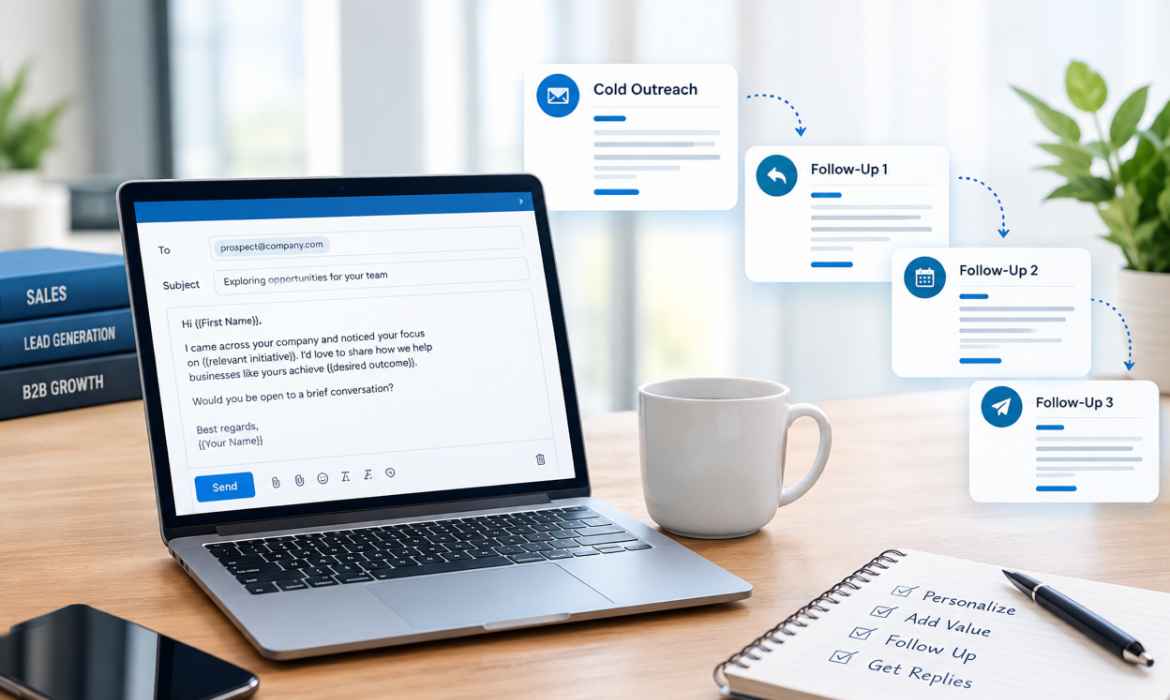
1. Introduction Email Template
An introduction email is useful when contacting a prospect for the first time. Its purpose is to introduce your business, establish relevance, and create an opportunity for further discussion.
Subject: Exploring opportunities for [Company Name]
Hi [First Name],
I came across [Company Name] and noticed your focus on [specific business activity or initiative].
I wanted to introduce myself and share how we help businesses improve [relevant business outcome]. Our approach focuses on helping teams address challenges related to [specific problem].
Would you be open to a brief conversation to explore whether this could be relevant to your current priorities?
Best regards,
[Your Name]
2. Problem-Solution Email Template
This approach works well when the sales representative understands a challenge commonly faced by companies in the prospect’s industry. Rather than starting with a product introduction, the email focuses on a specific business problem and presents a possible solution. As a result, the message feels more relevant and encourages meaningful engagement.
Subject: An idea for improving [Business Process]
Hi [First Name],
Many companies in [Industry] face challenges with [specific business problem], which can affect productivity, operational efficiency, or revenue growth.
We work with businesses to address these challenges through [solution or service]. This helps teams improve [specific outcome] while reducing the effort required to manage existing processes.
Would it be worth discussing how this approach could support your team?
Regards,
[Your Name]
3. Personalized Account-Based Outreach Email
Account-based outreach is useful when targeting high-value organizations with specific business requirements. Instead of sending the same message to multiple contacts, sales representatives can tailor their communication to individual accounts and decision-makers.
Subject: Supporting [Company Name]’s growth priorities
Hi [First Name],
I noticed that [Company Name] is focusing on [business initiative, expansion, or strategic priority]. As your organization continues working toward these objectives, [relevant challenge] may become an important consideration.
We help businesses in similar situations improve [business outcome] through [solution].
I’d be interested to understand how your team currently approaches this area. Would you be available for a short discussion?
Best regards,
[Your Name]
B2B Sales Email Templates for Follow-Ups
Sending an initial email is only one part of the outreach process. Many prospects do not respond immediately because they are busy, evaluating priorities, or waiting for the right time to consider a solution.
A relevant follow-up can bring the original conversation back to their attention. However, repeatedly sending the same message rarely creates value. Each follow-up should provide additional context, answer a possible question, or introduce a useful business insight.
The following B2B sales email templates cover different follow-up situations.
1. First Follow-Up After No Response
The first follow-up should be short and professional. It reminds the prospect about the earlier email without making them feel pressured to respond.
Subject: Re: [Original Email Subject]
Hi [First Name],
I wanted to follow up on my previous email regarding [specific business challenge or solution].
I understand you may have other priorities at the moment. However, this could still be relevant to your team’s efforts around [business objective].
Would you be interested in a brief conversation?
Best regards,
[Your Name]
2. Value-Based Follow-Up Email
Instead of simply asking whether the prospect has reviewed your previous message, share something useful that gives them another reason to engage.
Subject: An insight on [Relevant Business Topic]
Hi [First Name],
I wanted to share a quick thought related to [specific industry challenge or business priority].
Many organizations are exploring ways to improve [relevant process or outcome]. One area worth considering is [useful recommendation or approach].
I thought this might be relevant to your team’s current objectives. Would you be open to discussing it further?
Regards,
[Your Name]
3. Follow-Up After a Sales Meeting
After a sales meeting, send an email that summarizes the discussion and confirms the next steps. This keeps everyone aligned and reduces the possibility of misunderstandings.
Subject: Following Up on Our Discussion
Hi [First Name],
Thank you for taking the time to speak with me about [discussion topic].
As discussed, your team is currently looking to improve [specific requirement or challenge]. Based on our conversation, I believe [solution or approach] could help address this requirement.
I’ve included the relevant information for your reference. Please let me know if you have any questions or would like to discuss the next steps.
Looking forward to staying in touch.
Best regards,
[Your Name]
4. Final Follow-Up or Breakup Email
When multiple attempts have not received a response, a final follow-up can help close the outreach sequence professionally. It should give the prospect an easy way to respond without creating pressure.
Subject: Should I Close the Loop?
Hi [First Name],
I’ve reached out a few times regarding [business challenge or solution] and understand that this may not be a current priority.
I’ll close the loop for now rather than continue filling your inbox. If improving [relevant business outcome] becomes important in the future, I’d be happy to reconnect.
Thank you for your time.
Best regards,
[Your Name]
Best Practices for Using B2B Sales Email Templates
Templates can improve sales productivity, but their effectiveness depends on how teams use them. Sales professionals should treat each template as a flexible framework rather than a fixed message.
Consider these practices when planning an email outreach campaign:
1. Research Before Sending: Understand the prospect’s company, industry, role, and possible business requirements. Even a small amount of relevant research can make the message more meaningful.
2. Keep Emails Focused: Avoid lengthy introductions, excessive product details, and multiple requests. Concentrate on one business problem and one clear next step.
3. Personalize Every Important Touchpoint: Adjust the subject line, opening sentence, and value proposition according to the prospect’s priorities. Personalization should go beyond inserting a first name or company name.
4. Test and Improve Your Messaging: Experiment with different subject lines, opening statements, and calls to action. Evaluate positive replies and qualified meetings to understand which messages generate meaningful sales conversations.
5. Maintain Professional Follow-Up Timing: Give prospects enough time to review and respond. Space follow-ups across business days and avoid sending repetitive messages too frequently. Stop contacting prospects when they decline or request no further communication.
How to Build a Better B2B Sales Email Outreach Strategy
Successful email outreach requires more than writing good messages. Sales teams also need a clear process for identifying prospects, prioritizing accounts, managing conversations, and measuring results.
Start by defining your ideal customer profile (ICP). Identify the industries, company sizes, job functions, and business characteristics that match your offering. This helps representatives focus their efforts on relevant decision-makers instead of sending messages to broad, unqualified contact lists.
Next, organize prospects according to their buying stage and level of engagement. A new contact requires a different approach than someone who has downloaded a resource, attended a webinar, or requested a product demonstration. Matching the message to the buyer’s level of interest makes communication more relevant.
Data quality also plays an important role. Inaccurate contact details, outdated job information, and poorly matched accounts can reduce outreach effectiveness. Sales teams should use verified business information and relevant intent signals to improve prospect selection and prioritize meaningful opportunities.
Finally, measure campaign performance beyond email opens. Track reply rates, positive responses, qualified meetings, opportunities created, and conversions. These indicators provide a clearer understanding of whether your B2B sales email templates are contributing to pipeline development and business growth.
Turn Better Email Outreach into Qualified B2B Opportunities
Effective B2B outreach begins with reaching the right decision-makers and communicating a message that reflects their business needs. Well-structured email templates help sales teams maintain consistency, save time, and build more meaningful conversations throughout the buying journey. However, lasting results depend on accurate prospect data, thoughtful personalization, relevant follow-ups, and continuous performance improvement.
At Acceligize, we help B2B organizations strengthen their demand generation and lead acquisition efforts through first-party audience intelligence, precision targeting, content syndication, and intent-driven engagement. By connecting businesses with relevant audiences and qualified prospects, we support sales and marketing teams in building stronger pipelines and creating better opportunities for growth. Explore how Acceligize can support your B2B lead generation strategy at Acceligize.
What makes a B2B sales email effective?
An effective B2B sales email has a relevant subject line, personalized opening, clear value proposition, and simple call to action. It should address a specific business challenge and explain how the proposed solution can help. Keeping the message concise and relevant can encourage decision-makers to respond.
How many follow-up emails should you send in B2B sales outreach?
Sales teams can start with three to five follow-up emails, depending on the prospect’s engagement and outreach strategy. Each message should provide additional value rather than repeating the original pitch. If a prospect declines or requests no further communication, stop the outreach.
What is the best subject line for B2B cold sales emails?
The best subject line is short, relevant, and connected to the recipient’s business priorities. Examples include “Improving Your Sales Outreach Process,” “An Idea for [Company Name],” and “Exploring Opportunities for Growth.” Avoid misleading or overly promotional subject lines.
How can businesses improve B2B sales email response rates?
Businesses can improve response rates by targeting relevant decision-makers, using verified contact information, personalizing messages, and focusing on specific business challenges. Testing different subject lines and calls to action can also reveal what resonates with prospects. Tracking positive replies and qualified meetings helps measure actual outreach effectiveness.