


Marketing teams today manage multiple activities at the same time, including lead generation, email campaigns, audience segmentation, lead nurturing, and performance tracking. Handling these activities manually can slow down campaigns and make it difficult to maintain consistent communication with potential buyers. This is where marketing automation workflows become valuable for B2B organizations. They help teams organize repetitive marketing activities, respond to prospect behavior, and deliver relevant communication throughout the buying journey.
Unlike basic email automation, marketing automation connects different marketing activities through predefined triggers, actions, and conditions. For example, when a prospect downloads a whitepaper, the system can automatically send a follow-up email, update the prospect’s engagement score, and notify the marketing team when the contact shows stronger buying interest. These connected activities help B2B teams manage leads more efficiently while maintaining meaningful interactions with potential customers.
What Are Marketing Automation Workflows?
Marketing automation workflows are structured sequences of automated actions that take place when a specific condition or trigger is met. These workflows allow businesses to manage marketing tasks without requiring someone to perform every action manually. Depending on the prospect’s behavior, the system can send emails, assign lead scores, update contact information, or move prospects into different nurturing campaigns.
For B2B companies, these workflows are particularly useful because purchasing decisions often involve multiple stakeholders and longer evaluation periods. A prospect may interact with several pieces of content before considering a sales conversation. Therefore, marketing teams need a consistent way to track these interactions and respond with relevant information.
For instance, someone visiting a pricing page may have different interests from someone downloading an introductory industry guide. An effective workflow recognizes these differences and adjusts communication accordingly. This makes marketing automation more than a time-saving solution. It becomes a practical way to improve the overall lead management process.
Why B2B Teams Need Marketing Automation Workflows
B2B marketing involves several interconnected activities, and managing them separately can create communication gaps. A prospect might receive the same email multiple times, remain unnoticed after showing buying interest, or receive sales communication before being ready. These situations can affect the quality of the customer experience.
Marketing automation workflows help address these challenges by connecting campaign activities and establishing clear communication rules. Once a workflow is configured, teams can manage recurring interactions based on prospect actions, engagement levels, and predefined qualification criteria.
Another important advantage is better coordination between marketing and sales teams. When both departments work with consistent lead information, sales representatives can understand how a prospect interacted with previous campaigns. Marketing teams can also identify which activities contribute to stronger engagement and more qualified opportunities.
Additionally, automation supports scalability. As a business generates more leads, the marketing team does not need to increase manual follow-up activities at the same rate. Instead, well-designed workflows can handle routine communication while employees focus on campaign strategy, audience research, and relationship building.
7 Practical Marketing Automation Workflows for B2B Teams
Understanding the concept is useful, but seeing how these workflows operate in real marketing situations makes their value clearer. The following examples demonstrate how B2B teams can use automation to improve lead management, engagement, and sales readiness.
1. Lead Capture and Welcome Email Workflow
The first interaction after a prospect submits a form can influence how they perceive a business. However, delayed responses may reduce their interest, especially when they are researching multiple providers at the same time.
A lead capture workflow starts when someone completes a website form, registers for a webinar, or downloads a resource. The automation platform records the contact information and sends an immediate confirmation or welcome email. Depending on the form submission, the prospect can also be added to a relevant audience segment.
For example, someone downloading a guide about B2B demand generation can receive a confirmation email followed by related educational content. Meanwhile, a person requesting a product demonstration should enter a different process because their intent may indicate stronger interest.
This workflow helps businesses acknowledge prospect actions quickly and establish a consistent first interaction. It also ensures that new contacts enter the appropriate marketing process without unnecessary manual work.
2. Lead Nurturing Email Workflow
Not every prospect is ready to speak with a sales representative after their first interaction. Some buyers need additional information about industry challenges, possible solutions, and business outcomes before making a decision.
A lead nurturing workflow addresses this requirement by delivering relevant content over a planned period. It usually begins when a prospect downloads an educational resource or subscribes to a newsletter. The system then sends a sequence of emails containing useful information, such as industry insights, case studies, research reports, and practical guides.
For example, a company researching customer acquisition strategies might initially receive an educational article. A few days later, the workflow could share a case study explaining how similar businesses improved their acquisition process. If the prospect continues engaging, the system can introduce more detailed resources.
The important factor is relevance. Sending the same sequence to every contact can create unnecessary communication. Instead, B2B teams should develop nurturing workflows around industry, business requirements, professional roles, and demonstrated interests.
3. Lead Scoring and Qualification Workflow
Generating a large number of leads does not automatically produce more sales opportunities. Marketing teams must identify which prospects demonstrate meaningful interest and are more likely to enter a sales conversation.
A lead scoring workflow assigns points to contacts based on their profile information and engagement activities. For instance, visiting a pricing page, registering for a product demonstration, or repeatedly engaging with high-value content may indicate stronger interest. Job title, company size, industry, and other relevant business details can also contribute to qualification.
Once a contact reaches a predefined score, the workflow can update their lead status or notify the appropriate sales representative. However, scoring should consider both engagement and profile suitability. A highly engaged contact who does not match the target customer profile may not represent a valuable sales opportunity.
This process helps marketing and sales teams prioritize follow-ups more effectively. It also reduces the time spent manually reviewing every new contact.
4. Webinar Registration and Follow-Up Workflow
Webinars are an important channel for B2B companies because they provide opportunities to educate potential buyers and understand their interests. However, managing registrations, reminders, attendance records, and post-event communication manually can become difficult.
A webinar workflow begins when someone registers for an online event. The system sends a confirmation email and schedules reminders before the session. After the webinar, contacts can be divided into different groups based on whether they attended, registered but did not attend, or participated actively.
Attendees may receive the presentation, recording, and additional resources related to the discussion. Registrants who missed the session can receive a recording along with an invitation to explore other relevant content. Meanwhile, prospects who ask detailed questions or request additional information can be flagged for appropriate follow-up.
This approach ensures that webinar engagement continues beyond the live session. It also helps marketing teams identify contacts who may be interested in a deeper conversation.
5. Website Behavior-Based Automation Workflow
Website activity can provide useful information about what potential buyers are researching. However, simply recording page visits is not enough. Marketing teams need a structured way to respond when visitors demonstrate particular interests.
A behavior-based workflow uses predefined website actions as triggers. These may include visiting specific service pages, downloading resources, viewing case studies, or returning to important website sections multiple times.
For example, a prospect who repeatedly visits a page about B2B lead generation services may receive relevant educational content explaining lead generation strategies and qualification approaches. If the visitor submits an inquiry form, the workflow can move the contact into a more direct follow-up process.
Website behavior should always be interpreted carefully. A single page visit does not necessarily indicate purchasing intent. Combining multiple interactions with contact details and engagement history provides a more useful understanding of prospect interests.
6. Re-Engagement Workflow for Inactive Leads
Some prospects stop interacting with marketing campaigns even after showing initial interest. They may become busy, postpone their purchasing decisions, or simply lose interest in the information they were receiving.
Instead of permanently leaving these contacts inactive, businesses can create a re-engagement workflow. The process begins when a contact has not opened or interacted with relevant campaigns for a predefined period.
The workflow can send a personalized email containing fresh industry insights, useful resources, or an invitation to explore recently published content. If the prospect responds, they can return to an appropriate nurturing sequence. Contacts who remain inactive can be moved into a lower-frequency communication segment according to the company’s email preferences and consent requirements.
This approach helps marketing teams maintain healthier contact databases while avoiding unnecessary messages to disengaged audiences.
7. Marketing-to-Sales Handoff Workflow
A smooth transition between marketing and sales is essential for managing qualified B2B prospects. However, this process can become inconsistent when marketing teams identify interested contacts but fail to communicate important engagement details to sales representatives.
A marketing-to-sales handoff workflow begins when a prospect meets predefined qualification criteria. The system can update the contact’s status, assign the lead to an appropriate sales representative, and send an internal notification.
The sales team should receive useful context, including the prospect’s company information, content interactions, campaign history, and recent activities. This information allows representatives to prepare more relevant conversations instead of starting with generic outreach.
The workflow should also include a feedback process. If sales representatives determine that a prospect is not ready for a sales conversation, the contact can return to a suitable nurturing sequence. This creates a more connected process between the two departments.
How Marketing Automation Workflows Connect the B2B Buying Journey
Individual workflows become more effective when they operate as part of a connected marketing process. A prospect may first discover a business through an industry report, download a resource, attend a webinar, and later request a consultation. Each interaction provides information that can guide the next communication.
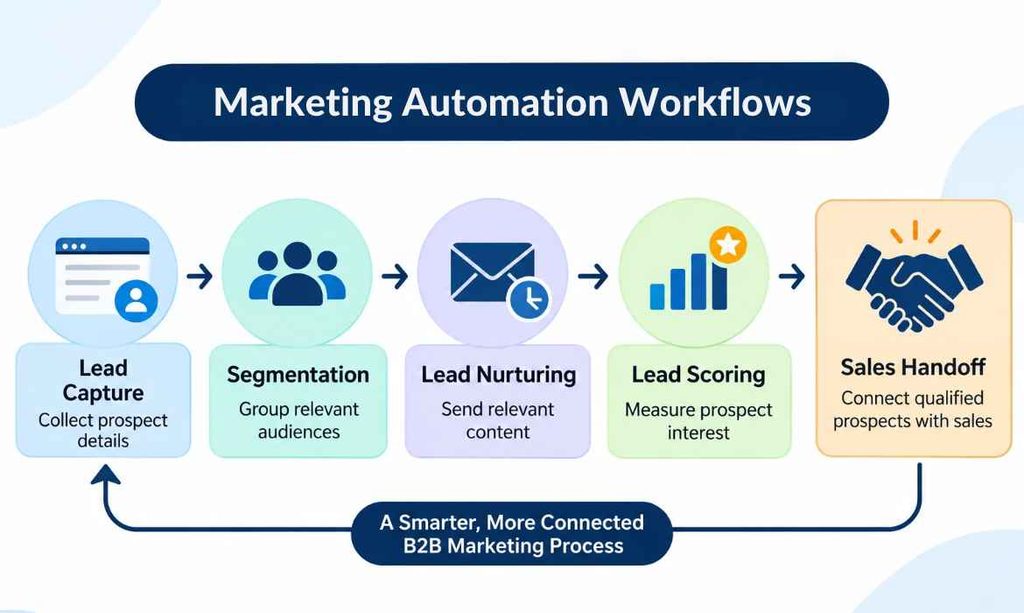
The infographic below illustrates how a connected B2B marketing automation process moves prospects through different stages, starting with lead capture and audience segmentation, followed by automated nurturing, engagement tracking, lead scoring, qualification, and sales handoff. It provides a visual explanation of how different workflows work together rather than operating as separate marketing activities.
When these stages are properly connected, marketing teams can maintain consistent communication without treating every prospect in the same way. For example, an early-stage prospect may receive educational resources, while someone showing stronger buying signals can enter a qualification process. This makes the overall buying journey more relevant and organized.
Best Practices for Building Effective Marketing Automation Workflows
Successful automation depends on the quality of the strategy behind it. Before creating a workflow, B2B teams should identify the business objective and understand which prospect action should trigger the process. A workflow designed to nurture new leads will require different conditions from one intended to identify sales-ready prospects.
Audience segmentation is equally important. Contacts should be grouped using relevant information such as industry, company size, job role, business interests, and engagement behavior. This helps marketing teams deliver useful communication instead of sending identical messages to an entire database.
Teams should also review their automation rules regularly. Outdated email sequences, incorrect contact details, duplicate records, and poorly configured triggers can affect campaign performance. Testing workflows before launching them helps identify errors and prevents unnecessary communication.
Finally, marketing and sales departments should agree on lead qualification criteria and follow-up expectations. Automation can support the process, but both teams need a shared understanding of what makes a prospect suitable for sales engagement.
Measuring the Performance of Marketing Automation Workflows
Tracking performance helps businesses understand whether their automation strategy is producing meaningful results. Email open rates and click-through rates can provide an initial view of campaign engagement, but they should not be the only measures of success.
B2B teams should also examine lead conversion rates, marketing-qualified leads, sales-qualified leads, and the number of opportunities generated through automated campaigns. These indicators provide a clearer picture of how marketing activities contribute to the sales pipeline.
Another useful measure is lead response time. When qualified prospects receive timely follow-ups, sales teams have a better opportunity to continue conversations while interest is active. Similarly, monitoring workflow drop-off points can reveal where prospects stop engaging.
Regular performance reviews help teams identify which messages, triggers, and content formats work effectively. Based on these findings, businesses can adjust their workflows and improve results over time.
Build a More Connected B2B Marketing Process with Acceligize
Effective marketing automation requires more than sending scheduled emails. It depends on accurate prospect information, relevant audience segmentation, meaningful engagement, and a clear connection between marketing and sales activities.
As B2B buying journeys become more complex, businesses need reliable processes to identify potential buyers and understand their interests. Combining well-planned automation with quality lead generation and data-driven targeting can help marketing teams create stronger opportunities for sales.
Explore how Acceligize can support your B2B lead generation and demand generation initiatives. Visit Acceligize to discover solutions that help businesses connect with relevant audiences, improve prospect engagement, and build a more effective pipeline.
What are the most effective marketing automation workflows for B2B companies?
Some of the most effective workflows include lead nurturing, lead scoring, webinar follow-ups, website behavior tracking, email engagement, and marketing-to-sales handoffs. These workflows help B2B companies manage prospect interactions and identify potential sales opportunities.
How do marketing automation workflows improve lead generation?
Marketing automation workflows improve lead generation by capturing prospect information, organizing contacts into relevant segments, and delivering targeted communication. They also help marketing teams identify engaged prospects and prioritize leads that are more likely to convert into sales opportunities.
Which marketing automation metrics should B2B teams track?
B2B teams should monitor email click-through rates, lead conversion rates, marketing-qualified leads (MQLs), sales-qualified leads (SQLs), lead response time, and campaign-generated opportunities. Tracking these metrics helps businesses understand workflow effectiveness and identify areas for improvement.
How can small B2B businesses implement marketing automation workflows?
Small B2B businesses can start with simple workflows such as automated welcome emails, lead nurturing sequences, and form submission follow-ups. They should focus on one business objective at a time, maintain accurate contact data, and gradually introduce lead scoring and sales handoff automation as their marketing activities grow.